
Your walk-in cooler is climbing into the danger zone but the dining room is a comfortable 72. Do you call the HVAC company or the refrigeration company? Get it wrong and you lose a day of response time on a problem measured in spoiled inventory. Here is exactly where comfort cooling ends and commercial refrigeration begins — and how to make the right call the first time.
| 10+ YearsServing Temecula Valley | C-20 LicensedCA Lic. #1070401 | EPA 608Certified Technicians | Free EstimatesOn Replacements |
Every restaurant, market, and food-service operator in the Temecula Valley eventually hits this fork. A cooling system goes down, and the first instinct is to call whoever you called last time. But comfort HVAC and commercial refrigeration are two related-but-separate trades, with different equipment, different refrigerants in some cases, and — in California — different license classifications. Calling the wrong one wastes the most valuable thing you have in a food emergency: hours.
Jorge runs SoCal AC Guy as a C-20 HVAC contractor, CA Lic. #1070401, based in Temecula. That means comfort cooling and heating — the rooftop units, split systems, and ventilation that keep your space at 72 and your customers in their seats. This guide is written to save you a phone call: it tells you plainly what a C-20 HVAC pro handles, what belongs to a C-38 refrigeration contractor, and where the two trades overlap enough that the honest answer is ‘either one can look at it.’
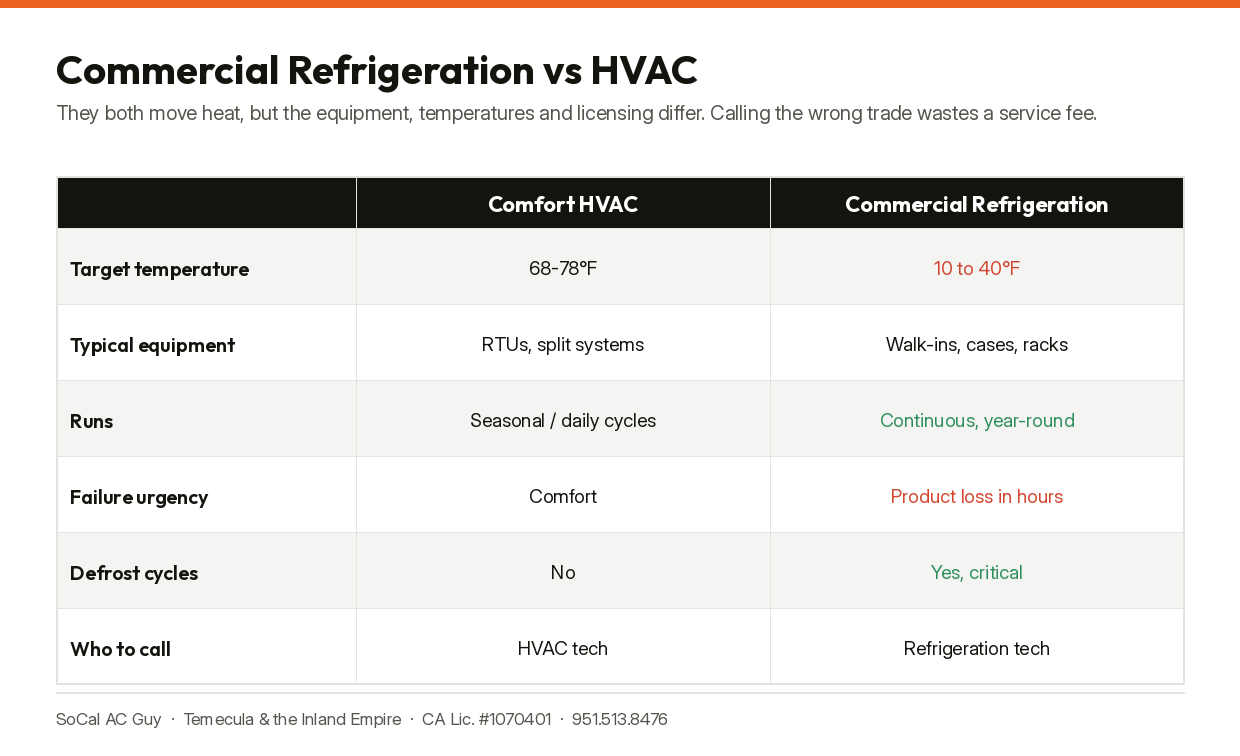
Both trades move heat with a refrigeration cycle — a compressor, a condenser, an evaporator, and a metering device. The physics is the same. What differs is the mission. HVAC keeps people comfortable. Refrigeration keeps product cold. That single distinction drives almost every practical difference you care about as a business owner.
Comfort cooling targets a room in the low 70s and cycles off once it gets there. Commercial refrigeration holds a tight, low setpoint — 34 to 40 degrees in a cooler, below zero in a freezer — around the clock, every day, with food safety and shelf life riding on it. Because the stakes and the temperatures are different, the equipment, controls, and even the licensing diverge.
If the thing that broke keeps people comfortable, you want a C-20 HVAC contractor. If it keeps product cold, you’re usually looking at commercial refrigeration.
California is unusually clear about this, because the Contractors State License Board splits the two trades into separate classifications.
A C-20 contractor is licensed for comfort systems: forced-air furnaces, central and packaged air conditioning, heat pumps, ductwork, economizers, and ventilation. That is SoCal AC Guy’s classification — CA Lic. #1070401. When your rooftop unit over the dining room quits, your office is at 84 degrees, or your ventilation isn’t keeping up, that’s C-20 work. See our commercial HVAC service overview for what that covers.
A C-38 refrigeration contractor is licensed to build and service refrigerated rooms, walk-in coolers and freezers, reach-in units, display cases, and process cooling. In California, a food-service operator replacing a walk-in cooler specifically needs a C-38 contractor. The C-38 classification exists because low-temperature, product-preservation systems are their own discipline.
There is real overlap in training — many technicians hold both skill sets, and the underlying refrigeration cycle is shared. But the license classification is the bright line California draws, and it tells you who is authorized to legally perform and permit each type of work.
Here is the fast reference. Print it, tape it inside the manager’s office, and you’ll never lose a day to the wrong phone call again.
| Equipment / Problem | Trade to Call |
|---|---|
| Rooftop unit (RTU) over dining room / retail floor | HVAC (C-20) |
| Split-system AC for the office | HVAC (C-20) |
| Space feels stuffy / poor ventilation / high CO2 | HVAC (C-20) |
| Makeup air unit / kitchen exhaust balance | HVAC (C-20) |
| Economizer stuck / bringing in hot outside air | HVAC (C-20) |
| Walk-in cooler / freezer not holding temp | Refrigeration (C-38) |
| Reach-in coolers, prep tables, display cases | Refrigeration (C-38) |
| Ice machine not producing | Refrigeration (C-38) |
| Beer / wine cooler, keg box | Refrigeration (C-38) |
| Refrigerated warehouse / cold storage room | Refrigeration (C-38) |
Quick reference for Temecula Valley food-service and retail operators. When in doubt, describe what the equipment cools — people or product — and the trade sorts itself out.
Most of the time the split is obvious. But a handful of gray areas send owners to the wrong trade, so it’s worth naming them.
A small server room that overheats is technically a ‘process cooling’ load, but the fix is almost always a dedicated mini-split or a small package unit — comfort equipment installed for a non-comfort reason. That’s C-20 HVAC work. If your server closet in a Murrieta office is tripping on hot afternoons, an HVAC pro handles it.
Temecula wine country has a specific version of this. A tasting room needs comfort cooling (C-20). A barrel room or cellar holding a tight 55–60°F for the wine is a light refrigeration / process load that often uses purpose-built cellar cooling units. We cover the distinction in our winery HVAC guide and the deeper production side in winery production facilities.
Some older Valley buildings have creative setups where one contractor installed everything. When a problem could be either side, an honest HVAC pro will tell you within one visit whether it’s in their lane or whether you need a refrigeration specialist — instead of guessing on your dime.
The reason this matters isn’t pedantry about license numbers. It’s time. Picture a Friday lunch rush in Temecula:
The same trap runs in reverse. Call a refrigeration tech for a rooftop comfort unit and you’ve burned the same day. Matching the trade to the equipment on the first call is worth real money — often more than the repair itself.
As a C-20 contractor, Jorge’s lane is comfort: the rooftop units, split systems, ventilation, economizers, and the restaurant air balance that decides whether your dining room ever actually keeps up in triple-digit heat. When you call about a comfort problem, that’s handled directly.
When you call and it turns out to be refrigeration, you get a straight answer on the first visit — what it is, why it’s out of C-20 scope, and what to look for in a refrigeration contractor — instead of a wasted trip charge. That honesty is the whole point of understanding the crossover: the fastest path back to a cold walk-in and a comfortable dining room is knowing exactly who to call before you dial.
One more Valley-specific note: the 2025 R-454B refrigerant transition is reshaping comfort equipment, while commercial refrigeration is on its own separate low-GWP timeline. If a contractor blurs those two transitions together, it’s a sign they’re not fluent in the difference either.
Describe the equipment and we’ll tell you straight whether it’s a C-20 HVAC job or a refrigeration call — before anyone rolls a truck. Serving Temecula, Murrieta, and Menifee.
It’s refrigeration. In California, servicing or replacing a walk-in cooler or freezer falls under the C-38 refrigeration classification, not C-20 HVAC. A comfort-cooling contractor keeps people comfortable; a refrigeration contractor keeps product cold.
Some technicians hold both skill sets because the refrigeration cycle is shared, but the work requires the matching California license — C-20 for comfort HVAC and C-38 for refrigeration. SoCal AC Guy is a C-20 HVAC contractor, CA Lic. #1070401, focused on comfort cooling, heating, and ventilation.
That’s usually an HVAC and air-balance issue, not refrigeration. A kitchen that runs hot is typically a makeup-air or exhaust-balance problem where the hood pulls out more air than the system replaces. A C-20 HVAC contractor diagnoses and corrects it.
Because a contractor can only work within their license and expertise. If an HVAC tech arrives at a refrigeration problem, they’ll tell you it’s out of scope and you start over with a second company — often losing half a day while product sits in the danger zone. Matching the trade to the equipment on the first call avoids that.
No — those are commercial refrigeration equipment under the C-38 classification. SoCal AC Guy handles comfort HVAC: rooftop units, split systems, ventilation, and economizers for Temecula Valley businesses. If you call about refrigeration, we’ll tell you honestly on the first contact so you don’t lose a trip charge.
SoCal AC Guy provides commercial comfort HVAC across Temecula, Murrieta, and Menifee, plus Wildomar, Lake Elsinore, Winchester, Canyon Lake, and French Valley. For restaurants and retail, see our commercial HVAC hub.
Jorge — C-20 HVAC contractor, CA Lic. #1070401.
Comfort cooling emergencies, RTU service, and straight answers for Temecula Valley food-service and retail. Jorge picks up.
Call (951) 513-8476
Contact SoCal AC Guy
Written by Jorge the AC Guy — SoCal AC Guy, Temecula, CA | C-20 HVAC | CA Lic. #1070401
Other guides that answer the questions this one usually raises: