
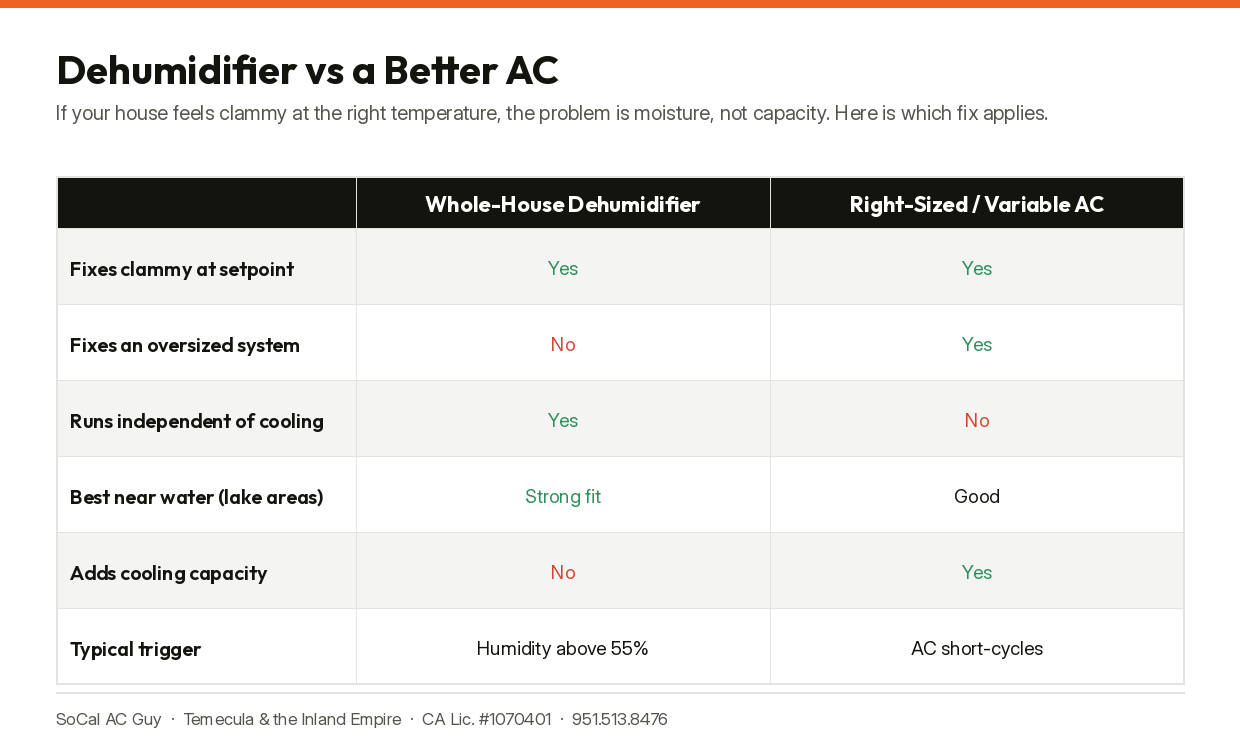
Short answer: for most Temecula, Murrieta, and Menifee homes, a properly-sized variable-speed AC fixes the humidity problem better than a $2,800 add-on dehumidifier. The exceptions are real but narrow — monsoon-week sufferers, lake-adjacent homes, very tight new-construction houses, and crawlspace-prone older homes. Here’s the honest 2026 math, with real indoor humidity targets and what each solution actually costs.
There’s a comfortable lie that gets repeated about Southern California: “we don’t have humidity.” If you’ve lived in Temecula through a monsoon week in July, you know that’s only partly true. Riverside County’s annual average humidity sits in the 55–65% range, which is materially higher than most homeowners assume. During the 5–10 day monsoon windows we get every summer (typically July through early September), indoor humidity in an undersized or short-cycling AC system can creep into the 65–75% range — well past the 50–55% sweet spot that feels good and prevents mold.
I’m Jorge — owner of SoCal AC Guy (CA Lic. #1070401), C-20 HVAC. I get the dehumidifier question every summer, usually from homeowners who just spent a sticky weekend running the AC nonstop and watching it cool the house but never feel right. This guide walks through what’s actually causing the discomfort, when a whole-house dehumidifier is the correct fix, and when an HVAC upgrade is the smarter spend.
Every air conditioner dehumidifies as a byproduct of cooling. Warm air pulls across the cold evaporator coil, moisture condenses on the coil, runs into the drain pan, and exits through the condensate line. A properly-sized AC running properly long cycles strips real water out of your house — typically 5–15 gallons of liquid water per day during a Temecula heat wave.
That dehumidification only happens when the AC actually runs. A 5-ton single-stage AC dropped into a house that only needs 3 tons of cooling will satisfy the thermostat in 8 minutes, shut off, and leave the indoor humidity untouched. The house “feels cool” because the air temperature dropped, but the dew point in the room is still high enough that surfaces feel clammy. This is the most common comfort complaint I diagnose in IE homes — oversized single-stage equipment short-cycling during mild weather and during monsoon humidity.
A variable-speed inverter AC running at 30–60% capacity for long, slow cycles strips moisture continuously. A two-stage AC does the same job somewhat less effectively. A single-stage 80% AFUE AC at full blast for 8 minutes barely dehumidifies. Same square footage, same outdoor weather, dramatically different indoor comfort.
Before deciding what equipment to buy, you need to know what you’re aiming for. Here’s the working IAQ science.
| Indoor Relative Humidity | What Happens at This Level |
|---|---|
| Below 30% | Dry sinuses, static shocks, wood furniture cracking, eczema flares. |
| 30–40% | Winter Temecula range — comfortable, dry, low mold risk. |
| 40–55% | Sweet spot. Most comfortable, lowest dust mite activity, lowest mold risk. |
| 55–65% | Tolerable but noticeable. Some allergy sufferers struggle. |
| 65–75% | Sticky discomfort. Dust mites and mold thrive. Wood floors can swell. |
| Above 75% | Visible condensation on windows, mold colonization begins within 24–48 hours on cellulose materials. |
Target indoor humidity for IE homes year-round: 45–55% in summer, 30–45% in winter. A $25 hygrometer from Amazon tells you where you actually are. If your current AC is keeping you under 55% even during a monsoon week, you don’t have a humidity problem — you have a comfort perception problem that’s probably about temperature setpoint or radiant load through windows. If you’re routinely measuring 60%+ indoors during summer, you have a real problem worth solving.
A whole-house dehumidifier is a standalone appliance that ducts into the home’s HVAC system (usually tied into the return plenum) or runs as a separate dedicated ducted unit. It pulls air across its own cold coil, condenses out the moisture, and returns dried air to the house. The big-name residential units are Aprilaire (E-series), Honeywell TrueDry, Santa Fe, and Carrier Performance Series.
Capacity: Sized in pints of water removed per day. Residential whole-house units typically come in 70, 90, 130, and 155 pint/day configurations. A 2,400 sqft Temecula home during monsoon season typically needs an 90–130 pint/day unit.
Installed cost (2026): $2,200–$3,800 for a 70–90 pint unit with ductwork tie-in, condensate drain, dedicated 20A circuit, and a humidity-aware thermostat or standalone humidistat. $3,400–$5,200 for a 130–155 pint unit. Add $400–$900 if your existing return plenum needs to be enlarged or relocated.
Operating cost: Roughly $30–$80 per month during the months it runs (mostly summer). It does add a small electrical load but it also reduces the AC’s runtime because it’s shedding latent heat (moisture) more efficiently than the AC alone.
Lifespan: 10–14 years with regular filter changes and an annual coil cleaning.
The other approach is to fix the dehumidification problem at the root by replacing an undersized, oversized, or single-stage AC with a properly-sized variable-speed inverter AC. Variable-speed units modulate continuously between roughly 25% and 100% capacity, running long, slow cycles that strip enormous amounts of moisture out of the indoor air.
Installed cost (2026): $14,800–$19,800 for a quality variable-speed 18–20 SEER2 AC + matching coil. If you’re already due to replace an aging AC, the marginal cost over a single-stage replacement is $2,500–$5,000.
Operating cost: Variable-speed inverter ACs are 25–40% more efficient on annual cooling kWh than the single-stage units they typically replace. Summer SCE bills typically drop by 15–30%.
Dehumidification performance: Significantly better than a single-stage AC. Comparable to a dedicated dehumidifier in most operating conditions, except during very mild weather when the AC barely runs and a separate dehumidifier still has a role. See our Variable-Speed vs Single-Stage AC comparison for the technical detail.
I bring a calibrated hygrometer and a manometer on every IAQ consult. We measure what’s actually happening in your house before recommending equipment. No commission, no guessing, no upsell.
A whole-house dehumidifier is the smarter spend in several specific situations. If your existing AC is relatively new (under 7 years) and otherwise performing well, replacing it just for humidity would be wasteful — adding a dehumidifier is a far cheaper way to solve the latent-load gap.
Lake-adjacent homes: Properties in Canyon Lake, around Lake Elsinore, or near the Vail Lake corridor see materially higher ambient humidity than the Temecula valley floor. AC alone often can’t catch up during summer. Dehumidifier as a permanent supplement makes sense.
Tight new-construction homes: Homes built to 2020-or-later California Title 24 standards are dramatically tighter than older IE homes. The reduced air leakage that saves energy also reduces passive moisture removal. Combined with mandatory mechanical ventilation that introduces outdoor air during humid mornings, tight new homes can run higher indoor humidity than the older houses next door. Dehumidifier solves it cleanly.
Crawlspace and basement moisture sources: Older homes in parts of Hemet and the older edges of Temecula and Murrieta sometimes have crawlspaces with persistent ground moisture migrating up into living space. The AC can’t keep up because moisture is being added continuously from below. Crawlspace encapsulation + dehumidifier is the proper fix.
Specific allergy or mold sensitivities: Households with documented dust mite allergy, asthma, or recent mold remediation history benefit from tighter humidity control than the 50–55% an AC alone usually achieves. A dehumidifier holds the target at 45% year-round.
For most Temecula, Murrieta, Menifee, Wildomar, and French Valley homes — the broad valley floor majority — the AC upgrade beats the dehumidifier on total cost and outcome. The trigger conditions:
Your AC is 10+ years old and approaching end of life anyway. Spending $2,800 on a dehumidifier when the AC will need replacement in 2–3 years is bad sequencing. Replace with variable-speed now, address humidity at the root.
Your existing system is oversized. If a Manual J calculation shows your house only needs 3 tons and you have a 4 or 5 ton single-stage installed, the AC is short-cycling and dehumidification is collateral damage. The right-size variable-speed unit eliminates the root cause. See our Manual J AC Sizing Guide.
You’re already considering replacement. The marginal cost to upgrade from a single-stage 14 SEER2 replacement to a variable-speed 18 SEER2 replacement is $2,500–$5,000 — close to what a standalone dehumidifier costs. The AC upgrade also delivers cooling efficiency, quieter operation, and better resale value. Better return on that incremental spend.
You don’t want a second system to maintain. A dehumidifier needs annual filter changes, coil cleaning, condensate drain checks. It’s another box in the garage that can fail. Some homeowners prefer one system that does everything well.
When I get a humidity complaint call in Temecula or Murrieta, the diagnostic workflow runs in this order. First, I measure actual indoor RH at three locations and at three times of day with a calibrated hygrometer. Second, I check AC sizing against the house’s current Manual J load — not what was originally installed, what the house actually needs today. Third, I check duct leakage, filter condition, and refrigerant charge. Fourth, I look at exterior moisture sources (crawlspace, irrigation, lake proximity, recent landscape watering changes).
If the AC is oversized or end-of-life: AC replacement is the answer. If the AC is properly sized and under 7 years old but the house still runs 60%+ RH: dehumidifier add-on. If both are true (oversized aging AC AND lake-adjacent or new-construction tight envelope): variable-speed AC replacement plus a smaller-capacity dehumidifier as the belt-and-suspenders solution.
In probably 7 out of 10 humidity calls I run, the answer is AC-related, not dehumidifier-related. The honest contractor’s job is to diagnose before recommending. See our Indoor Air Quality in Temecula guide for the broader IAQ picture — humidity is one of four levers you have for IAQ, alongside filtration (MERV ratings), ventilation, and source control.
If a dehumidifier turns out to be the right answer, the brand landscape is narrower than the AC market. The units that hold up well in IE conditions:
Aprilaire E-Series (E70, E80, E100, E130): The market workhorse. Strong build quality, sane control logic, reliable parts availability. The E80 and E100 cover most IE residential applications well.
Santa Fe Compact and Ultra series: Higher-end build, longer warranty, quieter operation. Sized more for high-humidity climates so they’re often oversized for IE applications — but the build quality is excellent for the lake-adjacent and crawlspace applications.
Honeywell TrueDry: Good value, integrates cleanly with Honeywell thermostats and IAQ systems already in many IE homes. Solid mid-tier choice.
Carrier Performance DEH: Manufacturer-matched dehumidifier for Carrier-equipped homes, integrates with Infinity controls. Premium pricing.
Most Temecula, Murrieta, and Menifee homes don’t — a properly-sized variable-speed AC handles dehumidification well across our climate. Exceptions where a dehumidifier earns its cost: homes near Canyon Lake, Lake Elsinore, or other waterways; tight new-construction homes built to 2020+ Title 24 standards; older homes with crawlspaces adding moisture from below; and households with documented allergy or mold sensitivities that need tighter humidity control than AC alone delivers.
45–55% relative humidity in summer; 30–45% in winter. Below 30% in winter, you’ll see static, dry sinuses, and wood cracking. Above 60% in summer, you’ll feel sticky and your dust mite and mold risk climbs sharply. A $25 hygrometer from Amazon tells you exactly where you are.
For a typical IE home, $2,200–$3,800 installed for a 70–90 pint/day Aprilaire or Honeywell unit ducted into the return plenum with a dedicated 20A circuit and humidistat control. Higher-capacity 130–155 pint units run $3,400–$5,200. Add $400–$900 if the return plenum needs to be enlarged or relocated to accept the connection.
In most IE homes, yes. Variable-speed inverter ACs run long, slow cycles at 25–100% capacity that strip far more moisture than a single-stage AC running short blast cycles. If your current AC is single-stage and oversized for the house, replacing it with a properly-sized variable-speed unit typically resolves humidity complaints without needing a separate dehumidifier. Lake-adjacent and tight new-construction homes are the main exceptions.
For a single room with a localized moisture problem, yes — a $200–$400 portable unit works fine. For whole-house comfort, no — a portable can’t keep up with the cubic footage of a typical IE home, and you’re emptying a bucket twice a day. Portables make sense for spot fixes (a damp closet, a den that runs warmer); whole-house units make sense for system-wide comfort.
Not directly. A dehumidifier removes moisture, not smoke particulate. For wildfire smoke and PM2.5 air quality issues, you need a high-MERV filter (MERV 13 or higher) and ideally a HEPA-grade portable unit or a fresh-air balancing system with HEPA filtration. See our Indoor Air Quality in Temecula guide for the full IAQ stack.
SoCal AC Guy installs whole-house dehumidifiers, variable-speed ACs, and full IAQ packages across Temecula, Murrieta, Menifee, Wildomar, Lake Elsinore, Winchester, Sun City, Canyon Lake, French Valley, La Cresta, De Luz, plus Hemet, Perris, Moreno Valley, and the broader Riverside County and North San Diego County service area.
Jorge — C-20 HVAC, CA Lic. #1070401. Aprilaire, Honeywell, Santa Fe, Carrier. Calibrated humidity measurement on every IAQ consult. Manual J load calculation. Honest recommendation whether you need new equipment or just better setup of what you have.
Call (951) 513-8476
Get a Free Estimate
Author: Jorge the AC Guy • C-20 HVAC • CA Lic. #1070401
Other guides that answer the questions this one usually raises: