
Three system types, three very different price tags, three very different operating cost profiles. A licensed C-20 HVAC contractor’s straight comparison for Temecula, Murrieta, Menifee, and the rest of the Inland Empire — including which one I’d put in my own house in 2026.
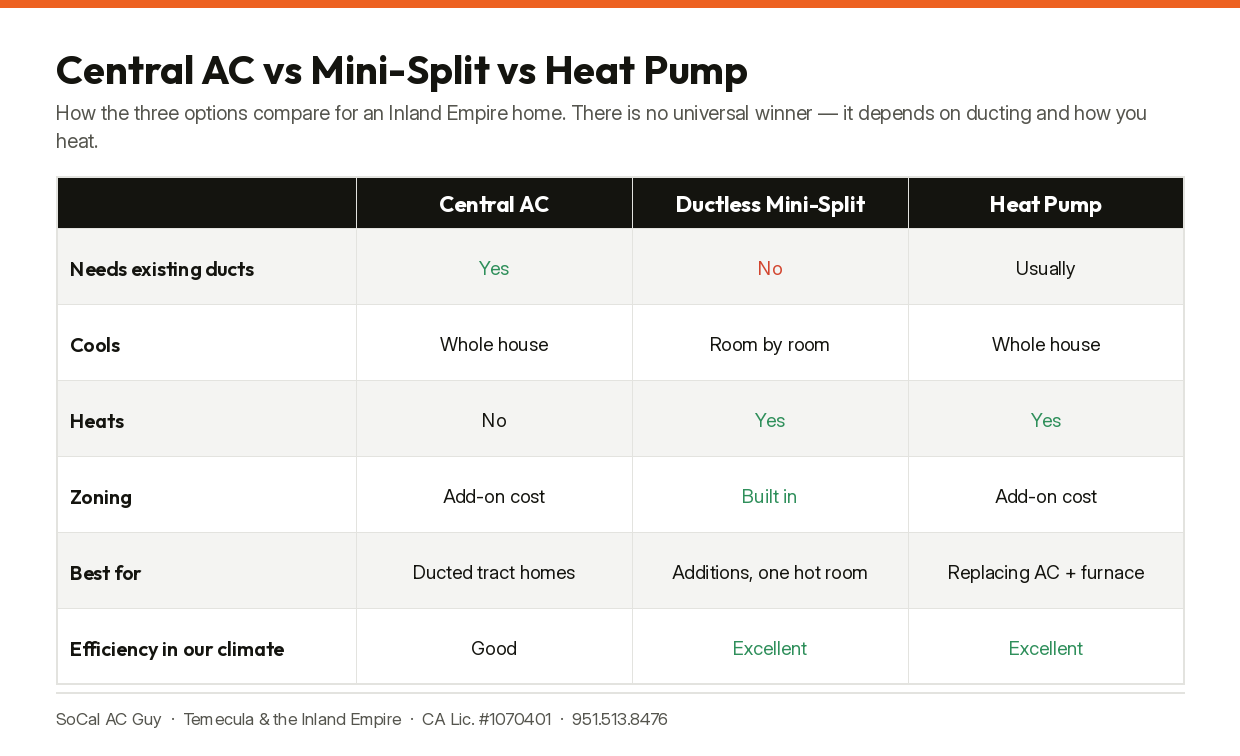
When a homeowner in Temecula calls me about replacing a 15-year-old system, three questions decide everything: is there existing ductwork worth keeping, what’s the budget, and how serious is the heating side of the equation. The answers determine whether the right system is traditional central AC, a ductless mini-split, or a modern heat pump. There is no universal “best” — each one is the right answer for a different house.
I’m Jorge — owner of SoCal AC Guy, C-20 HVAC, CA Lic. #1070401. I install all three system types across the Inland Empire and North San Diego County. This guide is the honest comparison — installed cost, operating cost, comfort profile, and the specific Temecula Valley conditions that push the decision one way or the other. By the end you’ll know which one fits your house, your budget, and the next 15 years of climate and rebate reality.
Central AC. An outdoor condenser plus an indoor air handler or furnace coil, connected by refrigerant lines, distributing cooled air through ducts to every room. The traditional Temecula tract-home setup. Cooling only — heating comes from a separate gas furnace or electric heat strip. Mature technology, best dealer support, lowest per-ton installed cost when ducts already exist.
Ductless mini-split. An outdoor condenser feeding one or more wall-mounted (or ceiling-cassette, or low-profile floor) indoor air handlers. Each indoor head has its own remote and runs independently. No ductwork. Inverter-driven, very efficient. Cools and heats. Best fit for homes without ducts, additions, ADUs, garage conversions, and any space where central duct distribution doesn’t reach well.
Heat pump. Mechanically very similar to a central AC, except the refrigerant cycle reverses to also provide heating in winter. Comes in two forms: ducted (replaces both your AC and your furnace) and ductless (mini-split heat pump). The economic and rebate case for heat pumps got dramatically stronger after 2023 — federal 25C credit, SCE rebates, and AQMD GoZero are all stacked on heat pumps right now. Strongest play for homeowners doing a full system replacement in 2026.
These are real 2026 ranges I’m seeing on quotes across Temecula, Murrieta, and Menifee. They reflect properly permitted, fully installed systems with R-454B refrigerant on the new platform — not the lowball cash-grab “$4,995 install” numbers you see on Facebook.
| System Type | Typical 2026 Installed Cost | Includes Heating? | Best Fit |
|---|---|---|---|
| Central AC (ducts exist) | $6,500 – $14,500 | No (existing furnace) | Standard tract home replacement |
| Central AC + new ducts | $11,500 – $22,000 | No (separate furnace) | Older homes, gut renovations |
| Mini-split, single zone | $4,500 – $7,500 | Yes | Single room, ADU, garage, addition |
| Mini-split, multi-zone (3–4 heads) | $10,500 – $17,500 | Yes | Whole home, ductless retrofit |
| Ducted heat pump (replaces AC + furnace) | $11,500 – $19,500 | Yes | Full system replacement with rebates |
| Dual-fuel (heat pump + gas furnace) | $13,500 – $22,000 | Yes (both fuels) | Larger homes, hedge against electric rates |
Ranges reflect 14.3 SEER2 minimum to premium variable-speed (24+ SEER2) tiers, 2-ton to 5-ton sizing, R-454B refrigerant, full permitting, electrical, and disposal. Excludes rebates. See New HVAC System Cost in Temecula and Mini-Split Installation Cost for full detail.
Central AC remains the default in the Temecula Valley because the housing stock already has ductwork. Most homes built between 1990 and 2020 in Temecula, Murrieta, Menifee, and Wildomar have a gas furnace in the attic or closet and a duct distribution system feeding registers in every room. When the condenser dies at year 15, the cheapest, fastest, most predictable replacement is another central AC condenser dropping onto the same pad, tied into the same line set and the same duct system.
Central AC wins when: ducts exist and are in usable condition; the existing furnace is less than 10 years old; the homeowner wants a 1:1 replacement with minimal change to the house; the budget is constrained. Modern central AC at 18 SEER2 is genuinely efficient — not as efficient as a top-tier heat pump or premium mini-split, but more than capable of running a Temecula home through a 110°F afternoon at reasonable cost.
Central AC loses when: the ductwork is shot. Leaky 1970s ducts in a hot attic can wipe out 25–35% of the system’s rated efficiency before the cool air gets to a room. If a duct inspection reveals widespread disconnects, gaps at the boots, undersized trunks, or returns starved for air, you’re sometimes better off going ductless and skipping the duct repair entirely. See Ductwork Repair vs Replacement.
Ductless mini-splits are the right answer more often than the conventional wisdom suggests. They’re not just for additions and garages anymore. Inverter-driven mini-splits from Mitsubishi Electric, Daikin, and Fujitsu hit 22–33 SEER2 — substantially higher than the best central systems — and because there are no ducts, they capture the full nameplate efficiency rather than losing 20% to duct losses on the way to the room.
Mini-splits win when: the home has no existing ductwork (a lot of Rainbow, La Cresta, and older Hemet homes); the duct system is unusable; the homeowner wants room-by-room temperature control (one head set to 68°F in the bedroom while the living room runs 72°F); a specific room runs hotter than the rest (a sunny west-facing addition, a converted garage workshop, a bonus room over a garage). Two-story Temecula homes where the upstairs is always 5–10°F hotter than the downstairs often benefit from a mini-split head dedicated to the upstairs zone, even when central AC remains downstairs.
Mini-splits lose when: the homeowner wants invisible HVAC. The wall-mounted indoor heads are visible — there’s a 36-inch white plastic head bolted to an interior wall in every conditioned room. Ceiling-cassette and low-profile floor units exist and look better, but cost more and take more skilled installation. Some homeowners also dislike the maintenance — each indoor head has filters that need cleaning every 1–3 months for the unit to hold its rated efficiency.
The hybrid approach. A common pattern in the homes I serve: keep the existing central AC for the main living areas, add 1–2 ductless heads to specifically target problem rooms — the master bedroom, the upstairs, or a hot office. Often the cheapest, fastest comfort improvement in a 15-year-old Temecula home. See Mini-Split Installation Cost in Southern California.
If you’re already doing a full system replacement in 2026, the heat pump deserves serious consideration. The economic, regulatory, and rebate picture has shifted hard in favor of heat pumps over the last 24 months and the trend is accelerating.
Why heat pumps make sense in the Inland Empire: Temecula winters are mild — average January lows hit the upper 30s, with hard freezes uncommon below the foothills. Modern heat pumps from Carrier, Trane, Lennox, Daikin, and Mitsubishi maintain full rated heating capacity down well below freezing. The “heat pumps don’t work in cold weather” line is dated. They work in the Inland Empire, easily.
The rebate stack. The federal 25C tax credit pays up to $2,000 for qualifying heat pumps installed in 2026. SCE has on-bill rebates of $1,000+ for ENERGY STAR-qualified heat pumps. SoCalGas offers efficiency incentives on hybrid (dual-fuel) installations. The AQMD GoZero program funds Riverside County heat pump conversions. Income-qualified households can layer additional rebates. The full rebate stack on a single ducted heat pump install can hit $4,000–$8,000 in 2026 — substantially closing the upfront premium versus a central AC + new furnace install. See Heat Pump Installation Cost in the Inland Empire + Every Available Rebate.
When a heat pump doesn’t make sense: If your gas furnace is less than 8 years old and working well, replacing it with a heat pump just to get the rebate is usually not the right financial move — let the furnace finish its life first. Very large homes (4,500+ sq ft) with deep heating loads sometimes pencil better on dual-fuel (heat pump + backup gas furnace) than on pure heat pump. Homes with terrible insulation should fix the envelope before changing fuel source — otherwise you’re paying for performance the house can’t capture.
I’ll come out, evaluate your house, run a Manual J load calc, and give you three written quotes — central AC, ductless mini-split, and heat pump — with rebate stacking applied. You see the math on your specific house before you spend $10,000+. Free, no pressure, no upsell.
Installed cost is one number. The bigger number, on a 15-year horizon, is what each system costs to operate. SCE residential rates climbed to a $0.32–$0.40/kWh weighted average in 2026 (tiered/TOU dependent), which makes efficiency increasingly valuable year over year.
A 1,800–2,200 sq ft Temecula tract home running typical cooling loads:
Baseline central AC at 14.3 SEER2: roughly $1,600–$1,950/year in cooling energy plus separate gas heating costs ($350–$650/year typical). Total HVAC energy: ~$2,000–$2,600/year.
Premium central AC at 18 SEER2: $1,275–$1,560 in cooling + gas heating, total ~$1,650–$2,200/year.
Ducted heat pump at 18 SEER2 / 9 HSPF2: $1,200–$1,500/year combined cooling and heating. Heating cost is electric instead of gas, but the heat pump’s coefficient of performance (3.0–4.0 typical) means you’re getting 3–4 units of heat per unit of electricity — far more efficient than gas combustion at typical Temecula winter temps.
Multi-zone mini-split at 22 SEER2: $900–$1,200/year — the lowest operating cost of any whole-house system, mostly because there are no duct losses and the inverter modulation matches actual load with remarkable precision.
Over a 15-year life, the operating-cost gap between a 14.3 SEER2 baseline central AC and a premium 22 SEER2 multi-zone mini-split adds up to roughly $10,500–$15,000 in saved electricity — often more than the entire installed-cost premium of going premium up front.
Cost is half the picture. Comfort is the other half. The three systems behave differently inside your house.
Central AC delivers a uniform house temperature when ducts are well-designed and balanced. Single-stage central systems cycle on and off — louder when running, full silent when off. Variable-speed central is much quieter and more even. Best fit when everyone in the house wants similar temperatures and a “set it and forget it” experience.
Mini-splits deliver excellent room-by-room control. The bedroom can run 68°F while the living room runs 72°F — heads operate independently. Inverter operation is remarkably quiet (most indoor heads measured at 22–30 dB, quieter than a whisper). Indoor heads are visible on the wall, which some homeowners dislike and others stop noticing within a week.
Heat pumps feel different in heating mode than a gas furnace. Gas heat dumps high-temperature (~120°F) air in short bursts. Heat pumps deliver lower-temperature (~95–105°F) air over longer cycles, which feels less “blast warm” and more “background warm.” Most homeowners adapt within a week; some prefer it. Auxiliary electric resistance or backup gas (in dual-fuel installs) handles the rare deep cold snap.
Triple-digit summer afternoons. All three system types are rated for our climate. The differentiator is how each holds capacity at design temperature (108°F+). Variable-speed inverter equipment — both central and mini-split — holds capacity best. Lower-tier single-stage equipment can degrade 15–20% at 108°F ambient versus its nameplate.
Wildfire smoke season. Central AC with a properly upgraded filter (MERV 11 or 13) does a better job pulling smoke and particulates out of the air than wall-mounted mini-split heads, which use thinner filtration. If wildfire smoke is a real concern, the central system has the advantage — or you add a portable HEPA unit to a mini-split house. See Wildfire Smoke and Your HVAC.
Dry desert wind. Santa Ana wind events can clog outdoor coils with debris quickly. All three system types have outdoor units exposed to the same conditions, so this is a maintenance variable rather than a system-type variable. See Santa Ana Wind HVAC Checklist.
SCE rate environment. Time-of-use pricing penalizes peak afternoon cooling hard. Higher-efficiency systems — premium central, mini-split, heat pump — all reduce peak-hour electricity draw substantially. The economic case for efficiency has gotten stronger every year as SCE rates climb.
1990s–2010s tract home, ducts in decent shape, furnace under 10 years old, condenser dead at year 15: Replace the condenser with a quality 16–18 SEER2 central AC. Cheapest, fastest, most predictable. ~$8,500–$12,500 installed.
Same house, but ducts are leaky and the furnace is also 15+ years old: Full system replacement to a ducted heat pump. Stack the federal 25C credit and SCE rebates. ~$11,500–$16,500 installed, ~$8,500–$13,000 net after rebates.
Older home with no central ductwork, or a major addition with no duct access: Multi-zone ductless mini-split (Mitsubishi M-Series or Daikin). Premium upfront, lowest operating cost, best room-by-room control. ~$10,500–$17,500 for a 3–4 zone install.
Two-story Temecula home with one persistently hot zone (upstairs, bonus room, west-facing office): Keep existing central AC, add a 1-zone ductless head to the problem room. Cheapest comfort improvement available. ~$4,500–$7,500 added to existing system.
Estate home in La Cresta or Canyon Lake, full replacement, owner planning to stay 15+ years: Dual-fuel premium variable-speed heat pump + gas backup. Quiet, efficient, hedges against either electric rate or gas price shocks. ~$16,500–$22,000 installed before rebates.
Yes — typically 30–40% cheaper to operate. Premium inverter-driven mini-splits at 22+ SEER2 capture their full rated efficiency because there are no ducts to leak through. A central system loses 20–30% of nameplate efficiency to duct losses in a typical attic install.
Yes. Modern heat pumps from Carrier, Trane, Lennox, Daikin, and Mitsubishi maintain full rated capacity down well below freezing. Temecula winters rarely drop below the upper 30s, well inside the comfortable operating range of any quality heat pump. The “heat pumps don’t work in cold weather” line is dated.
Yes, as long as the furnace is in good shape and the existing coil and air handler are compatible with the new R-454B refrigerant platform. Most furnaces 10 years old or newer pair fine with new condensers. Older furnaces may need a coil/blower upgrade alongside the new condenser.
For qualifying heat pumps: federal 25C tax credit up to $2,000, SCE rebates $1,000+, AQMD GoZero rebates (income-qualified), and some manufacturer rebates that come and go. Total stack typically lands $3,000–$8,000 depending on income tier and equipment.
Premium inverter mini-splits hold capacity remarkably well at extreme outdoor temperatures. Mitsubishi’s Hyper-Heat line and Daikin’s premium inverter compressors are rated to maintain full capacity well above 115°F outdoor. Budget mini-splits may degrade above 105°F — match the brand and tier to your peak temperature.
All three systems are designed for 15–20 year service lives when properly installed and maintained. Central AC and heat pump systems share most of their components and lifespans are comparable. Mini-splits with high-quality inverter compressors (Mitsubishi, Daikin, Fujitsu) routinely hit 18–22 years in field data.
SoCal AC Guy serves Temecula, Murrieta, Menifee, Wildomar, Lake Elsinore, Winchester, Sun City, Canyon Lake, and French Valley — plus surrounding Riverside County and North San Diego County.
Jorge — C-20 HVAC, CA Lic. #1070401. Side-by-side written quotes for central AC, ductless mini-split, and heat pump on your specific home — with rebates applied and Manual J load calculations included. 10+ years across the Temecula Valley.
Call (951) 513-8476
Get a Free Estimate
Author: Jorge the AC Guy • C-20 HVAC • CA Lic. #1070401
Other guides that answer the questions this one usually raises: