
SEER is dead. SEER2 is the law. A licensed C-20 HVAC contractor’s plain-English breakdown of what changed in 2023, what the California minimums actually are in 2026, and which efficiency numbers matter when you’re spending $10,000+ on a new system in Temecula heat.
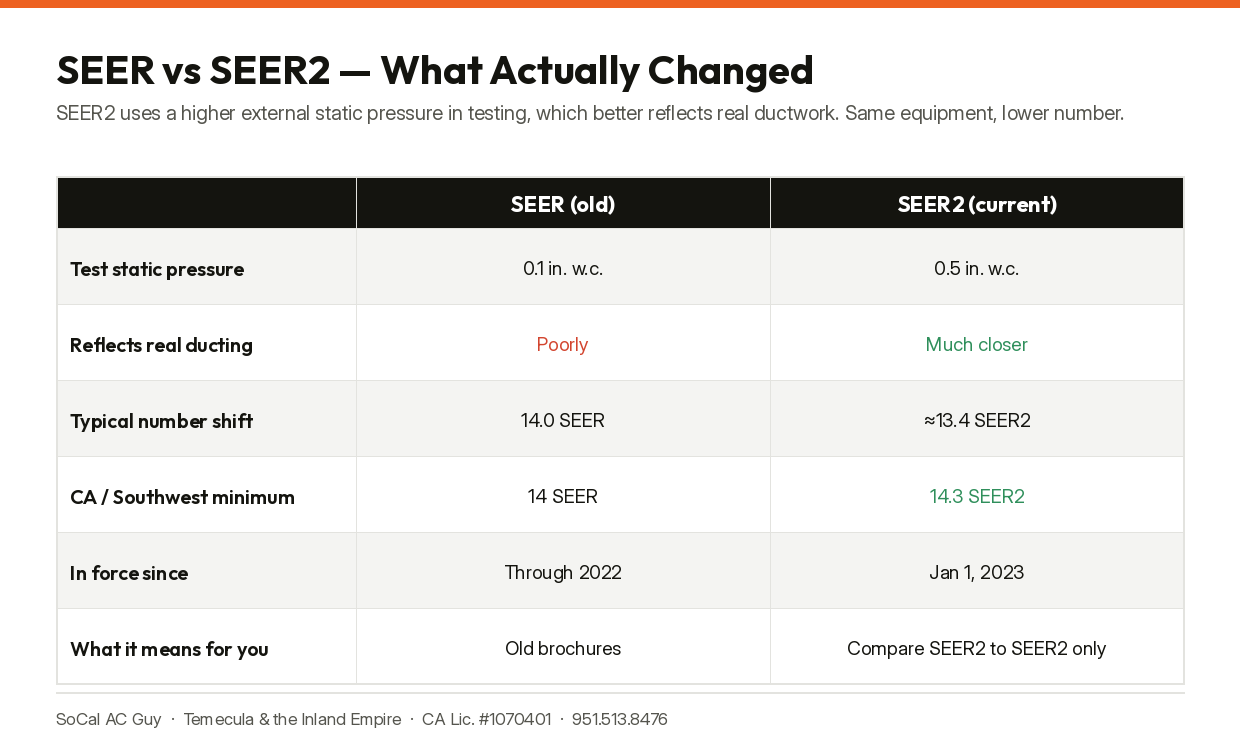
Every estimate I write in Temecula, Murrieta, and Menifee in 2026 lists the equipment with a SEER2 number — not a SEER number. Homeowners look at the spec sheet, see a “lower” number than they expect, and assume something is wrong. Nothing is wrong. The test changed. The same physical compressor that used to be marketed as a 15 SEER unit is now labeled 14.3 SEER2. The equipment didn’t get worse — the measurement got more honest.
I’m Jorge — owner of SoCal AC Guy, C-20 HVAC, CA Lic. #1070401. This guide is the version of “what is SEER2” I wish I could hand every homeowner before they get a quote. We’ll cover what changed, what the California minimum actually is in 2026, how the new R-454B refrigerant transition interacts with the standard, and — most importantly — which SEER2 number is actually worth paying extra for in the Inland Empire climate. The right answer is not “the highest you can afford.” See Best AC Brands for Southern California in 2026 for the brand-by-brand picture once you’ve decided on an efficiency tier.
SEER stands for Seasonal Energy Efficiency Ratio. It’s a number that estimates how much cooling output you get per unit of electricity consumed over a simulated cooling season. Bigger number, more efficient system. A SEER2 of 16 means the unit delivers 16 BTUs of cooling for every watt-hour of electricity it pulls, averaged across a season under the test protocol.
The “2” in SEER2 doesn’t mean it’s a different ratio. It means the test conditions used to produce the number got more rigorous. The Department of Energy switched the federal test procedure (Appendix M1) on January 1, 2023. The new test uses higher external static pressure to better simulate the ductwork most real homes actually have. It accounts for blower energy more accurately. It captures part-load operation closer to how systems actually run in the field.
Result: every system tested under SEER2 produces a slightly lower number than the same hardware tested under the old SEER protocol. The conversion factor varies by equipment type, but for residential split systems it’s roughly a 4.5% reduction. A 15.0 SEER unit becomes about 14.3 SEER2. A 20 SEER unit becomes about 19.1 SEER2. The hardware is identical. The honesty is higher.
The DOE divided the country into three regions: North, Southeast, and Southwest. California is in the Southwest region, along with Arizona, Nevada, and New Mexico. The Southwest carries the strictest minimums on the books because our cooling load is the heaviest in the country.
For residential split-system air conditioners under 45,000 BTU/hr (which covers essentially every home up through a 3.5-ton system), California’s minimum is 14.3 SEER2. Above 45,000 BTU/hr (4-ton and 5-ton systems), the minimum drops slightly to 13.8 SEER2. Heat pumps carry their own minimum: 14.3 SEER2 / 7.5 HSPF2 for split systems.
Anything below those numbers cannot be legally installed in California as new residential equipment. The federal enforcement mechanism is at the point of installation — not at the point of sale — so a 13 SEER2 unit sold cheaply online cannot be installed in Temecula or anywhere else in the state by a licensed contractor. If a contractor offers you a unit at a “great price” that doesn’t meet 14.3 SEER2, that’s an automatic disqualifier.
SEER2 is a seasonal average. In Lake Elsinore, Winchester, and Menifee, the question isn’t how efficient the system is on a 78°F afternoon. It’s how efficient it is when the outdoor coil is sitting in 108°F ambient on a Tuesday in August. That’s a different number — EER2 (Energy Efficiency Ratio 2).
EER2 measures steady-state efficiency at a single high-temperature test point: 95°F outdoor, 80°F indoor, 50% relative humidity. For Inland Empire homes, EER2 is a more honest predictor of summer power bills than SEER2. A system can post a great seasonal number while degrading severely at design temperature — that’s the system you don’t want in a Temecula heat wave.
Practical rule: ask for both numbers on every quote. For single-stage equipment, look for an EER2 of at least 11.7. For two-stage and variable-speed equipment, EER2 of 12.5+ is genuinely good. For premium variable-speed inverter equipment from Trane, Carrier, Lennox, Daikin, or Mitsubishi, expect EER2 in the 13–14 range — that’s where the dollar premium starts paying off in hot-climate operation.
HSPF2 (Heating Seasonal Performance Factor 2) is the equivalent number for the heat-pump heating mode. California’s heat pump minimum is 7.5 HSPF2 for split systems, but for hot-climate heat pump operation in our mild winters, HSPF2 of 8.1+ is the threshold for federal 25C tax credit eligibility. See Heat Pump Installation Cost in the Inland Empire + Every Available Rebate for the full rebate picture.
Here’s the practical translation of SEER2 numbers to real-world equipment behavior. Skip the marketing brochures.
The legal minimum. Single-stage compressor: it runs full-blast or it doesn’t run. Cycles on and off frequently. Decent for budget-constrained installs, rental properties, and homes where the owner won’t be there long-term. Goodman GSXN4 and the equivalent budget tiers from Carrier, Trane, and Lennox live here. Expect a 3-ton installed price in the $6,500–$9,500 range for a quality install in 2026.
The sweet spot for most Temecula Valley homes. Either a high-efficiency single-stage or an entry two-stage compressor. Two-stage compressors can run at a lower output for most of the day, only ramping up to full when it’s truly hot. Better dehumidification, quieter operation, lower utility bills. $8,500–$12,500 installed for a 3-ton in 2026.
Real two-stage operation or entry variable-speed. The compressor modulates output across a wider range. Excellent comfort, very quiet operation, and meaningful utility savings in the long run. Carrier Performance, Trane XR16/XL18, Goodman GSXC18, Amana AVXC20. $10,500–$14,500 installed for a 3-ton.
True inverter-driven variable-capacity systems. Lennox SL28XCV (28 SEER2), Carrier Infinity 26 (24 SEER2), Trane XV20i (21.5 SEER2), Daikin DX20VC. The compressor modulates continuously from ~30% to 100% capacity. The quietest, most efficient, most comfortable residential AC technology on the market. $13,000–$19,500+ installed for a 3-ton.
| SEER2 Tier | Typical Installed Price (3-ton) | Est. Annual Cooling Cost* | 15-Year Energy Savings vs Minimum |
|---|---|---|---|
| 14.3 SEER2 (minimum) | $6,500 – $9,500 | $1,600 – $1,950 | Baseline |
| 16 SEER2 | $8,500 – $11,500 | $1,440 – $1,755 | ~$2,400 – $2,900 |
| 18 SEER2 | $10,500 – $13,500 | $1,275 – $1,560 | ~$4,800 – $5,850 |
| 20 SEER2 | $12,500 – $15,500 | $1,150 – $1,400 | ~$6,800 – $8,250 |
| 24+ SEER2 (variable) | $14,500 – $19,500+ | $950 – $1,170 | ~$9,800 – $11,700 |
*Estimated for a 1,800–2,200 sq ft single-story Temecula Valley home running typical SCE residential rates (~$0.34/kWh weighted average in 2026). Assumes 1,800 cooling-equivalent hours per year. Actual results vary with shade, insulation, occupancy, and thermostat habits. Compare with New HVAC System Cost in Temecula.
The honest math: higher SEER2 always reduces your utility bill, but the upfront premium doesn’t always pay back inside the equipment’s service life. The variables that matter:
How long you plan to own the home. If you’re staying 10+ years in a hot-climate area like Lake Elsinore or Menifee, premium efficiency tends to pay back. If you’re flipping or relocating inside five years, you’re paying for efficiency you won’t capture.
Your local electricity rate. SCE residential rates have risen materially over the last five years, and tiered/time-of-use pricing punishes peak summer use hard. The higher your effective rate per kWh, the more a high-SEER2 system saves per year. Homes pulling 4,000+ kWh during the summer billing cycle see the strongest paybacks.
House envelope and shading. A 1990s tract home with single-pane windows and minimal attic insulation will benefit far more from any efficiency tier than a 2018 production build with R-38 attic insulation, dual-pane low-E glass, and west-facing eaves. If your envelope is the limiting factor, money spent on insulation and weather sealing often beats money spent on a SEER2 upgrade.
Whether you’ll capture the comfort benefit. Variable-speed systems aren’t just more efficient — they deliver quieter operation, better humidity control, and more even temperatures across the house. For two-story Temecula homes where the upstairs is always 5°F hotter than the downstairs, the comfort improvement alone is sometimes worth the premium. See HVAC for Two-Story Temecula Homes.
January 1, 2025 was the federal cutoff for manufacturing residential R-410A equipment under the AIM Act. Every new system installed in 2026 ships with R-454B (or, on certain mini-splits, R-32) — both are A2L low-GWP refrigerants with a global warming potential roughly 75% lower than R-410A.
From a SEER2 standpoint, the refrigerant change is neutral or slightly positive. The new platforms were redesigned around R-454B’s thermodynamic properties, and most manufacturers used the platform redesign as an opportunity to bump efficiency at the same time. A 2026 R-454B Carrier Performance unit is generally slightly more efficient than the 2024 R-410A Performance unit it replaced — same nameplate SEER2 number or marginally higher.
Two practical implications for buyers in 2026: (1) Avoid old-stock R-410A units sitting in warehouses — they meet the same SEER2 rating but their refrigerant is on a depreciating supply curve. (2) Confirm your installer has updated A2L refrigerant training and the right tools (electronic leak detection, mildly different brazing protocols). See 2026 R-454B Refrigerant Transition for the full transition picture.
I’ll come out, run a real Manual J load calc, look at your house envelope and SCE bill, and give you side-by-side written quotes at 16 SEER2, 18 SEER2, and 20+ SEER2 — so you can see the math on your actual home before you spend $10,000+. Free, no pressure.
Comparing a SEER number to a SEER2 number on different quotes. If one contractor quotes a 16 SEER system and another quotes a 15 SEER2 system, they’re not the same — they’re approximately the same. SEER2 is roughly 4.5% lower than the equivalent SEER. Always make sure all quotes are in SEER2 for an apples-to-apples comparison. In 2026 every legitimate quote should be SEER2; if anyone is still quoting in SEER, they’re likely selling old-stock equipment.
Buying a 20 SEER2 system but pairing it with leaky 1990s ductwork. Duct losses can wipe out 20–30% of the system’s nameplate efficiency before the cooled air ever reaches a register. A 16 SEER2 system with sealed and balanced ducts will outperform a 20 SEER2 system with leaky ducts every time. If you’re going premium on the box, also budget for ductwork inspection, sealing, and balancing. See Ductwork Repair vs Replacement.
Letting the contractor oversize the equipment. The published SEER2 number assumes the system runs in its designed operating range. An oversized 3.5-ton on a 2.5-ton load will short-cycle, never reach its efficient operating range, fail to dehumidify properly, and effectively perform like a much lower-SEER2 system. Manual J load calculation is mandatory for hitting nameplate efficiency. See How to Size an AC for Your Inland Empire Home (Manual J Explained).
Chasing rebates without reading the fine print. Federal 25C tax credit requires SEER2 ≥ 16 / EER2 ≥ 12 / HSPF2 ≥ 8.1 for heat pumps. SCE rebates layer on top with their own thresholds. SoCalGas and AQMD have separate program rules. A 14.3 SEER2 minimum-tier system is legal but generally won’t qualify for the high-value rebate stack. See Heat Pump Rebates in the Inland Empire for the current rebate landscape.
If I were replacing the system in my own house in Temecula in 2026: an 18–20 SEER2 two-stage or entry variable-speed unit from Carrier, Trane, or Goodman/Amana, paired with a properly sized variable-speed air handler, sealed and balanced ducts, and a Manual J load calculation. That tier captures the meaningful comfort and utility-cost benefits without paying for the 24+ SEER2 premium that mostly buys quieter operation and marginal additional savings.
For a rental property: 14.3–15 SEER2 single-stage, the cheapest qualifying installed option that’s properly sized and properly installed. For an estate home in La Cresta or Canyon Lake where the owner cares about quiet operation and is planning to stay long-term: a 24+ SEER2 variable-speed inverter system pays its premium back in comfort, quiet, and SCE bill reduction across a 15-year horizon.
No, but they measure the same thing — seasonal cooling efficiency. SEER2 uses a stricter DOE test procedure introduced January 1, 2023. Same equipment tested under SEER2 produces a number about 4.5% lower than under the old SEER protocol. The hardware didn’t change; the test got more realistic.
14.3 SEER2 for residential split-system air conditioners under 45,000 BTU/hr (up to 3.5 tons). 13.8 SEER2 for 4-ton and 5-ton systems. Heat pumps: 14.3 SEER2 / 7.5 HSPF2. California sits in the DOE’s Southwest region with the strictest minimums in the country.
Not always. The upfront premium for a 24 SEER2 system over a 16 SEER2 system can be $5,000–$8,000. Whether it pays back depends on how long you’ll own the home, your electricity rates, your envelope quality, and whether the ductwork can deliver the rated performance. For most Temecula Valley homes, 18 SEER2 is the value sweet spot.
EER2 measures efficiency at a single high-temperature test point (95°F outdoor). In hot Inland Empire summers, EER2 is a more honest predictor of peak-load efficiency than SEER2. For Temecula and surrounding hot-climate homes, look for EER2 of 11.7+ on single-stage, 12.5+ on two-stage, and 13+ on premium variable-speed equipment.
Approximately. The DOE conversion factor for residential split systems is about 0.95 — so a 15 SEER unit equals roughly 14.3 SEER2, and a 16 SEER unit equals roughly 15.2 SEER2. The exact conversion depends on equipment type and configuration. Manufacturer spec sheets typically publish both values for transition-era equipment.
The federal 25C residential energy efficiency tax credit requires SEER2 ≥ 16, EER2 ≥ 12, and (for heat pumps) HSPF2 ≥ 8.1, plus equipment listed on the CEE Highest Tier qualifying list. Credit is up to $2,000 for qualifying heat pumps, $600 for qualifying central AC. See Tax Credits for HVAC Upgrades — 25C, 25D for current rules.
SoCal AC Guy serves Temecula, Murrieta, Menifee, Wildomar, Lake Elsinore, Winchester, Sun City, Canyon Lake, and French Valley — plus surrounding Riverside County and North San Diego County.
Jorge — C-20 HVAC, CA Lic. #1070401. Manual J load calcs included on every estimate. Side-by-side SEER2 tier quotes so you can see the math before you spend. 10+ years across the Temecula Valley.
Call (951) 513-8476
Get a Free Estimate
Author: Jorge the AC Guy • C-20 HVAC • CA Lic. #1070401
Other guides that answer the questions this one usually raises: