
Hot dry winds, blown debris, wildfire smoke, and rolling AQI alerts — Santa Ana season hammers HVAC equipment across the Inland Empire. A C-20 HVAC contractor’s pre-season checklist for protecting your system, your indoor air, and your family.
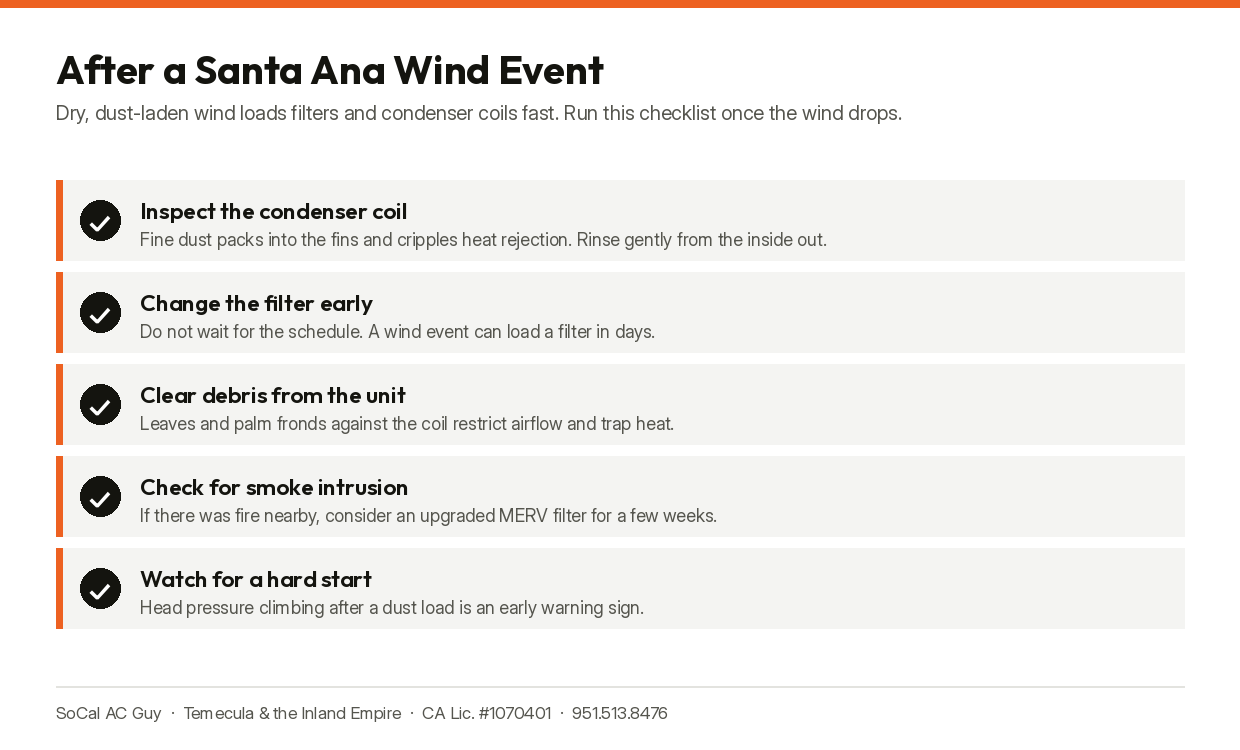
Santa Ana wind season runs roughly October through April in Temecula, Murrieta, Menifee, and the broader Inland Empire. The pattern is brutal on HVAC systems: hot dry winds funneling down from the Great Basin, gusts that can hit 60+ mph in the Temecula and Cajon passes, blown dust and palm fronds slamming outdoor condensers, and wildfire smoke pulling indoor AQI from the 30s into the 200s overnight.
I’m Jorge — owner of SoCal AC Guy (CA Lic. #1070401), C-20 HVAC. This is the pre-season checklist I run on my own equipment and on my customers’ systems every fall before Santa Ana conditions kick in. Most of it you can do yourself in under an hour. The rest is what to ask a licensed technician to handle on the next service visit.
Two factors stack up against your equipment. First, the wind itself: sustained 25–45 mph gusts during a typical Santa Ana event drive enormous volumes of dust, sand, pollen, palm debris, and tumbleweed into outdoor condenser coils. A fouled coil is a coil that can’t dump heat efficiently — the compressor works harder, the SEER2 efficiency drops, the energy bill goes up, and the system runs hotter than it was designed to.
Second, wildfire smoke. The San Bernardino Mountains form a natural bowl that traps air over the Inland Empire, and Santa Ana wind events frequently drive smoke from fires in San Diego County, the Cleveland National Forest, or the Cajon Pass directly into Temecula Valley airshed. AQI in Temecula and Murrieta can shift from “Good” to “Unhealthy” inside a few hours when fires are active. Indoor air quality becomes a real health concern, particularly for kids, seniors, and anyone with asthma or COPD.
Your HVAC system is your first line of defense on the smoke side and your most exposed asset on the wind side. Both pieces deserve attention before the season starts.
1. Clear a 24-inch perimeter around the unit. The condenser needs unobstructed airflow on all four sides. Pull back any landscaping, branches, debris piles, or stored items within 2 feet of the cabinet. Trees and shrubs that drop heavy seed pods or fronds (palms, jacarandas, pepper trees) should be trimmed back further — 4 feet is better.
2. Hose the coil fins clean from the inside out. Cut power at the disconnect first. With a standard garden hose (not a pressure washer — pressure washers bend fins and damage the coil), spray water through the coil from the inside of the cabinet outward, working top to bottom. This pushes accumulated dust, lint, and pollen out the same direction it came in, instead of driving it deeper. A bottle of foaming coil cleaner from any HVAC supply house ($12–$18) makes the job easier on heavily fouled units.
3. Inspect for fin damage. Bent fins reduce coil heat transfer. A fin comb (also at supply houses) straightens minor damage in five minutes. Heavy hail damage, impact dents, or large crushed sections need a technician.
4. Check the cabinet for impact damage and rust. Santa Ana winds occasionally drop large objects — pool umbrellas, patio furniture, branches — onto outdoor condensers. Look for dents, displaced panels, and any signs of refrigerant lines being struck or kinked. Surface rust on the cabinet is cosmetic; rust on copper lines or refrigerant fittings needs attention.
5. Verify the unit is level and secured. Walk around the pad. A condenser that’s tilted more than 1/4 inch puts stress on the compressor and refrigerant lines. Concrete pads in Menifee and Wildomar sometimes settle unevenly in expansive clay soils — a $200 pad re-set can save a $3,500 compressor.
6. Replace the air filter — with the right MERV rating. Standard MERV 8 filters handle routine dust and pollen. For Santa Ana season, I move customers to MERV 11 minimum, MERV 13 when the system can handle it. MERV 13 captures PM2.5 — the fine particulate that wildfire smoke is composed of — at rates that genuinely matter for indoor air quality. Verify your system’s manual to confirm it can handle the higher MERV without restricting airflow. Most modern furnaces and air handlers can; some older single-stage systems can’t. See MERV Ratings Explained — What Inland Empire Homes Actually Need.
7. Inspect visible ductwork for separations and damage. Walk the attic or crawlspace if accessible. Look for disconnected duct boots, crushed flex sections, and torn insulation. Even small duct leaks pull unconditioned attic air — which during a Santa Ana event is loaded with dust and smoke particulate — directly into your home. Leaky ducts effectively bypass your filter.
8. Check return-air register seals. Around the return grille, the filter housing should seal tight against the wall or ceiling. Gaps mean unfiltered air is being pulled past the filter. A roll of foil HVAC tape ($6) fixes this in under 10 minutes.
9. Test the thermostat’s fan-only mode. During active smoke events, you’ll want to run the system blower continuously (without active cooling) to push indoor air through the filter on a recirculation loop. Verify the fan setting on your thermostat works correctly. If it doesn’t, get it fixed before you need it.
For households with allergy or respiratory concerns, or homes in higher-fire-risk areas (the Temecula wine country, La Cresta, De Luz, Aguanga, and the mountain communities), a few hardware upgrades materially change Santa Ana season indoor air:
Whole-house air filtration cabinet. A dedicated MERV 13 or 16 filter cabinet ($400–$900 installed) replaces the standard 1-inch filter slot with a 4–5-inch media filter. Bigger surface area, much lower airflow restriction, and dramatically higher particulate capture. For wildfire smoke especially, this is the single best HVAC-side upgrade. See Wildfire Smoke and Your HVAC: Filtration, Sealing, and Recovery.
Portable HEPA air purifiers in bedrooms. Even with a strong HVAC filter, a HEPA portable unit in each main bedroom adds a layer of protection at the room level. Honeywell, Coway, and Levoit make solid units in the $200–$400 range. Run them on high during active smoke advisories. See Whole-House Air Purifiers vs Portable Units.
Door and window weather-stripping. An HVAC system can only filter the air it can pull into the return. If outside air is leaking in around doors and windows, you’re constantly fighting a losing battle. A weekend of weather-stripping work pays back through every smoke event for the next decade.
1. Close windows and exterior doors. Keep them sealed for the duration of the event. If you have whole-house fans or attic ventilation fans, turn them off — they pull outdoor smoke directly into the home.
2. Set the thermostat fan to ON (continuous), not AUTO. Continuous fan mode keeps air moving through the filter even when the AC or heat isn’t actively cycling. On a smoky day in Temecula, this is the single biggest move you can make for indoor air quality.
3. Check and change filters more often. Filters dirty fast during smoke events. Pull the filter every 3–5 days during an active event and replace it when it’s visibly loaded. Keep 4–6 spares stocked at the start of the season.
4. Avoid indoor combustion. No candles, no wood-burning fireplaces, no gas stove use beyond essentials. You’re trying to keep PM2.5 down — indoor combustion adds to the load your HVAC has to filter out.
5. After the event, inspect the outdoor unit again. Hose the coil clean. Pull any debris from the cabinet. A 10-minute post-event walk-around adds years to the system’s life.
Most of the above is homeowner work. A few items warrant a licensed C-20 contractor like SoCal AC Guy on a pre-season service visit:
A full coil cleaning with chemical foam if the unit hasn’t been professionally cleaned in 2+ years. Refrigerant charge verification — undercharged systems run hot and short on capacity during heat events. Capacitor and contactor inspection — these are the most common failure points and the inrush stress of frequent cycling during smoke-trapped heat days will find a weak one. Blower wheel inspection — a dust-loaded blower wheel can lose 30%+ of its rated airflow, and Santa Ana season is when it shows up in the form of warm air at the registers. Duct sealing if the home has known leakage problems — a one-day duct-seal project ($600–$1,400) pays back in efficiency and indoor air quality for years.
For the full annual maintenance flow, see Pre-Summer AC Tune-Up: The 12-Point Checklist and AC Maintenance Schedule for Inland Empire Homes.
I’ll come out, coil-clean the outdoor unit, verify refrigerant charge, inspect the blower, check capacitors and contactors, and walk you through MERV 11/13 filter and IAQ options before fire season starts. Honest pricing, no upsell.
Yes — with a high-MERV filter (11 or 13) and the thermostat fan set to continuous ON. Keep windows and exterior doors closed. The AC keeps recirculating indoor air through the filter, which captures PM2.5 from wildfire smoke. Don’t use whole-house fans or attic vent fans during a smoke event — those pull smoke directly into the home.
MERV 11 minimum, MERV 13 if your system can handle it without restricting airflow. MERV 13 captures PM2.5 — the fine wildfire-smoke particulate — at meaningful rates. Verify your equipment’s manual before going above MERV 11; some older single-stage systems can’t tolerate the airflow restriction of a 1-inch MERV 13 filter.
Yes. Santa Ana wind gusts (25–60 mph in the Temecula and Cajon passes) drive debris, sand, palm fronds, and occasionally larger objects into outdoor condensers. The most common damage is fouled coil fins and minor cabinet dents. Major impact damage (a tree branch or patio furniture striking the unit) can crush refrigerant lines or displace internal components.
Twice a year minimum — once in spring before summer load, once in fall before Santa Ana season. After any major wind event or visible debris accumulation, a quick hose rinse is appropriate. Have a licensed C-20 contractor do a chemical foam cleaning every 2 years for deeper buildup.
For most Inland Empire homes, upgrading to a 4–5-inch MERV 13 filter cabinet is the strongest first move — it handles whole-house filtration efficiently. Add portable HEPA units in bedrooms for an additional layer during active smoke events. Whole-house purifiers (electronic, UV-supplemented, or HEPA bypass) are a worthwhile upgrade for households with severe asthma or COPD.
SoCal AC Guy serves Temecula, Murrieta, Menifee, Wildomar, Lake Elsinore, Winchester, Sun City, Canyon Lake, French Valley, La Cresta, and De Luz — plus surrounding Riverside County and North San Diego County.
Jorge — C-20 HVAC, CA Lic. #1070401. Full pre-season tune-ups, MERV 13 filter upgrades, duct sealing, and whole-house IAQ retrofits across the Inland Empire. 10+ years local.
Call (951) 513-8476
Get a Free Estimate
Author: Jorge the AC Guy • C-20 HVAC • CA Lic. #1070401
Other guides that answer the questions this one usually raises: