
R-410A is gone. R-454B is here. A licensed C-20 HVAC contractor explains the AIM Act timeline, the A2L safety classification, the leak-detection sensors on new equipment, and exactly what changed about the price of a new AC in Temecula in 2026.
If you’ve been quoted a new AC in Temecula, Murrieta, or anywhere in the Inland Empire in 2026, you’ve heard the term “R-454B.” Maybe you’ve also heard “A2L,” “AIM Act,” or “leak sensor required.” The contractor in your driveway probably did a quick five-second version that left you wondering what just happened to your AC project. This article is the unhurried version — what the rule actually says, why it changed, what it costs you, and what to do if your existing R-410A system breaks down.
I’m Jorge — owner of SoCal AC Guy (CA Lic. #1070401), C-20 HVAC. I’ve been installing the new R-454B equipment since the manufacturers rolled it out in late 2024 and early 2025, and I’ve handled a fair share of post-transition service calls on the early systems. Here’s everything an Inland Empire homeowner actually needs to know.
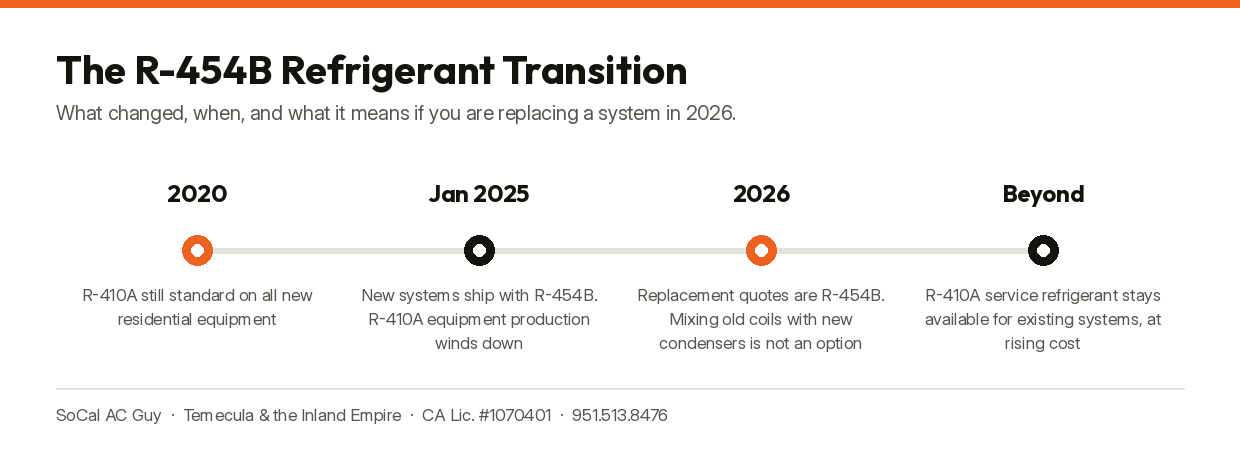
Federal law required new residential HVAC equipment manufactured for the U.S. market to switch from R-410A refrigerant (a high-GWP HFC) to a lower-global-warming-potential alternative starting in 2025. Manufacturers chose mostly R-454B (some chose R-32). By regulation, no new residential HVAC system installed in 2026 can use R-410A — the cutoff is hard, with full effect at the start of 2026. Existing R-410A systems can keep running and can still be serviced; you do not have to replace your working unit. New equipment is roughly the same installed cost as before, with a small premium for the required A2L leak-detection components built in.
That’s the headline. The rest of this article is the why and the how.
R-410A — the refrigerant that’s been in nearly every residential AC and heat pump installed since roughly 2010 — is a hydrofluorocarbon (HFC). HFCs are safe to handle and non-ozone-depleting, but they have a very high Global Warming Potential (GWP). R-410A’s GWP is approximately 2,088, meaning a pound of it released to the atmosphere has roughly 2,088 times the warming effect of a pound of CO₂ over a 100-year period.
The U.S. American Innovation and Manufacturing (AIM) Act of 2020 directed the EPA to phase down HFCs by 85% over 15 years. Under the EPA’s Technology Transitions rule, new residential AC and heat pump equipment manufactured or imported starting January 1, 2025 had to use refrigerants with a GWP below 700. R-410A doesn’t qualify. R-454B (GWP ≈ 466) and R-32 (GWP ≈ 675) do.
There was a brief manufacturing crossover in 2025 where existing R-410A inventory could still be installed. That sell-through window has now closed for new system installations as of January 1, 2026 in the U.S. residential market. From here forward, every new system in the Inland Empire ships with R-454B or R-32.
R-454B is a blend of two refrigerants: roughly 68.9% R-32 and 31.1% R-1234yf. It’s been on the market in commercial and European applications for years before residential adoption in the U.S. Its key properties:
GWP of approximately 466 — about 78% lower than R-410A.
Thermodynamic performance close to R-410A — energy efficiency is comparable, with most R-454B systems hitting equivalent or slightly higher SEER2 ratings than the R-410A units they replaced. Compressor design, line set sizing, and operating pressures are similar.
Classified A2L by ASHRAE Standard 34 — low toxicity, mildly flammable. This is the part that drives the safety-equipment requirements I’ll explain below.
Near-azeotropic blend — meaning it behaves close to a single-component refrigerant in normal service, with very small temperature glide. Practically, that means service procedures are similar to R-410A from a technician’s perspective.
This is the part homeowners worry about most, and the honest answer is: not in any way you should lose sleep over. The A2L classification means R-454B is “mildly flammable” in laboratory test conditions — it requires a specific air-to-refrigerant mixture, a sustained ignition source above roughly 1,300°F, and a confined space to combust. The refrigerant doesn’t easily ignite at standard household conditions.
For context, the natural gas piped into your kitchen stove is A3 — significantly more flammable than any A2L refrigerant. The propane tank on your patio grill is also A3. R-454B is a long way down the flammability scale from anything you already accept as routine in your home.
That said, the safety standards aren’t taking chances. UL 60335-2-40 (the safety standard governing A2L systems) requires every indoor unit that uses an A2L refrigerant to include an integrated refrigerant leak-detection sensor. If the sensor detects refrigerant in the indoor air at a defined threshold, it shuts the compressor down, locks the system out, and switches the indoor blower to a continuous mode to dilute and exhaust any leaked refrigerant. The system can’t restart until a technician clears the fault.
In other words: there’s an automatic, mandatory safety system that has to be on the system before it can ship. That’s a meaningful upgrade over the R-410A era, where leaks were detected only at the next service call (or when the bill spiked).
When the transition first started getting talked about, the industry was forecasting 10–15% installed-cost increases for R-454B equipment versus the outgoing R-410A platform. The reality in 2026 is more nuanced. The refrigerant itself costs slightly more per pound than R-410A at this point in the cycle, and the leak-detection sensor and associated control wiring add real cost to the indoor unit. But manufacturers absorbed a chunk of those increases as production scaled up.
The way it lands on a Temecula homeowner’s quote in 2026: an installed R-454B 3-ton split system typically runs $300–$900 more than the equivalent R-410A unit would have cost in 2024. Some of that is sensor cost, some is refrigerant cost, some is the wider line-set and safety-component requirements. For a complete pricing breakdown, see New HVAC System Cost in Temecula.
Where I see homeowners get stung is on repairs to existing R-410A systems, not on new installs. R-410A production for new systems has wound down dramatically. Refrigerant supply for the service market is being drawn from existing inventory and limited continued production for the service-only channel. The wholesale price per pound of R-410A has been creeping up and will keep creeping up. A refrigerant top-off on a 12-year-old R-410A system that used to cost $250 in 2023 may run $400–$600 in 2026, depending on the size of the charge needed.
Your existing R-410A AC or heat pump is legal to service and refill indefinitely. The phase-down rules apply to new equipment manufactured and installed, not to existing systems already in your home. If you have a 2014 Carrier 24ABB6 in good condition and the capacitor fails this summer, I can replace the capacitor and recharge the system normally. If you’ve got a 2018 Trane XR16 with a slow leak, I can fix the leak and refill with R-410A.
What changes is the math on whether it makes sense. If your system is 10+ years old, has lost a significant charge to a leak, and is hitting major-repair territory (compressor or evaporator coil), the calculation tilts more aggressively toward replacement than it did in 2023. The R-410A you’d top up with is more expensive than before and will keep getting more expensive. The R-454B system you’d install instead has 8–10 more years of expected life. See AC Compressor Replacement — Repair or Replace? for the decision framework.
A common question from homeowners trying to extend the life of an existing system: can the refrigerant be swapped out? The answer is no — and any contractor who tells you yes is either inexperienced or selling you something you don’t want.
R-454B and R-410A operate at different pressures, use different oils, and require fundamentally different equipment design (including the A2L leak sensors and rated electrical components). Pumping R-454B into an R-410A system would damage the compressor, void any remaining warranty, and create a real safety risk. A refrigerant conversion isn’t a thing in residential HVAC. If you want R-454B, you replace the equipment.
If you’re getting quotes from any HVAC contractor in Temecula, Murrieta, Menifee, or anywhere in Riverside County, here are the questions that separate the pros from the rest:
“Is this equipment R-454B or R-32?” Both are legal in 2026 and both work well. Some Daikin and Mitsubishi mini-splits use R-32; most Carrier, Trane, Lennox, Goodman, and Amana split systems use R-454B. You want a clear answer — not “the new refrigerant.”
“Does the indoor unit include the integrated leak-detection sensor?” It’s required by code on new A2L systems. If the answer is anything but yes, the contractor is either trying to install old non-compliant inventory or doesn’t understand the rule. Walk away.
“Are you certified to handle A2L refrigerants?” EPA Section 608 universal certification is required for HVAC technicians to handle any refrigerant. Manufacturers also require updated training on A2L handling for warranty coverage on R-454B equipment. A reputable contractor will be able to confirm both immediately.
“What’s the labor and parts warranty?” Most major brands offer 10-year parts on registered R-454B equipment. Labor warranty varies by contractor — anywhere from 1 to 10 years. The leak-detection sensor is typically covered under the same parts warranty as the rest of the indoor unit.
Most existing line sets and duct systems work fine with R-454B without modification. The refrigerant operating pressures are close enough to R-410A that the same copper line sets and brazing techniques apply. Where I do see issues is on older systems where the existing line set has accumulated trash, moisture, or residual mineral oil from a much earlier R-22 conversion. R-454B is happier on cleaner installations.
For older Inland Empire homes — Sun City, parts of Hemet, and the original tracts in Murrieta — I always recommend a line-set flush at minimum on the R-410A-to-R-454B swap, and often a full line-set replacement on systems older than 20 years. The cost differential is small and the system longevity benefit is significant.
Don’t panic-replace a working R-410A system because of the transition. If your unit is running well, has no leaks, and isn’t past 12 years old, keep using it. Service it. Top it off when needed. The phase-out doesn’t force you out of your equipment — it only governs what’s available for new installs.
If you’re replacing anyway because the system is old or failing, R-454B is a solid platform. The efficiency is comparable, the safety integration is better, and the environmental footprint is genuinely improved. The leak sensor is a feature, not a tax — it gives you an early-warning system you didn’t have before.
Make sure your contractor is properly certified, is installing genuine R-454B equipment (not leftover R-410A old stock), and is pulling permits. Riverside County and the cities of Temecula, Murrieta, and Menifee all require permits on AC replacements, and the permit inspection now includes verification of the A2L safety components.
For broader context on shopping a 2026 HVAC system, see Best AC Brands for Southern California in 2026, SEER vs SEER2 Explained for Inland Empire Homeowners, and Variable-Speed vs Single-Stage AC — Worth the Upgrade in Temecula?
I’ll come out, evaluate your existing equipment, give you a straight answer on whether to repair or replace, and quote new R-454B options only if it actually makes financial sense. No upsell, no urgency tactics. Free estimate.
No. The EPA phase-down rules apply to new equipment manufactured and installed, not to existing systems already in your home. Your R-410A unit can be serviced and topped off indefinitely. You only need a new system when you’re replacing a failed or worn-out unit by choice.
Yes. R-454B is classified A2L (low toxicity, mildly flammable) under ASHRAE Standard 34. It’s significantly less flammable than the natural gas already piped into most homes. All new A2L equipment includes a mandatory integrated leak-detection sensor that shuts the system down and runs the blower if refrigerant is detected indoors — a safety upgrade over the R-410A era.
In the Temecula Valley in 2026, an installed R-454B 3-ton split system typically runs $300–$900 more than the equivalent R-410A unit would have cost in 2024. The increase reflects refrigerant cost, A2L leak-detection sensor, and updated electrical components. Energy efficiency is comparable to R-410A.
No. R-454B and R-410A operate at different pressures, use different oils, and require different equipment design including the A2L leak sensors. Refrigerant conversion isn’t a thing in residential HVAC. To use R-454B, you replace the equipment.
Yes — gradually. R-410A production for new systems has wound down dramatically, and supply for the service market comes from existing inventory and limited continued production. A refrigerant top-off on a 12-year-old R-410A system that used to cost $250 in 2023 may run $400–$600 in 2026.
Both are A2L refrigerants with GWP under 700. R-32 (GWP ≈ 675) is a single-component refrigerant used heavily by Daikin and Mitsubishi mini-splits. R-454B (GWP ≈ 466) is a blend of R-32 and R-1234yf used by most central split-system brands including Carrier, Trane, Lennox, Goodman, and Amana. Both are safe and efficient.
SoCal AC Guy serves Temecula, Murrieta, Menifee, Wildomar, Lake Elsinore, Winchester, Sun City, Canyon Lake, and French Valley — plus surrounding Riverside County and North San Diego County.
Jorge — C-20 HVAC, CA Lic. #1070401. EPA 608 certified, A2L trained, full warranty support on Carrier, Trane, Lennox, Goodman, Amana, Daikin, and Mitsubishi R-454B and R-32 systems. Free estimates across the Inland Empire.
Call (951) 513-8476
Get a Free Estimate
Author: Jorge the AC Guy • C-20 HVAC • CA Lic. #1070401
Other guides that answer the questions this one usually raises: