
Sealing a couple of leaks runs $375–$700. A full Inland Empire duct replacement runs $2,400–$7,200. The right answer depends on duct material, age, accessibility, and the symptoms you’re chasing. Here’s how a C-20 HVAC contractor decides, with real 2026 pricing and the warning signs that push a job from repair into replacement territory.
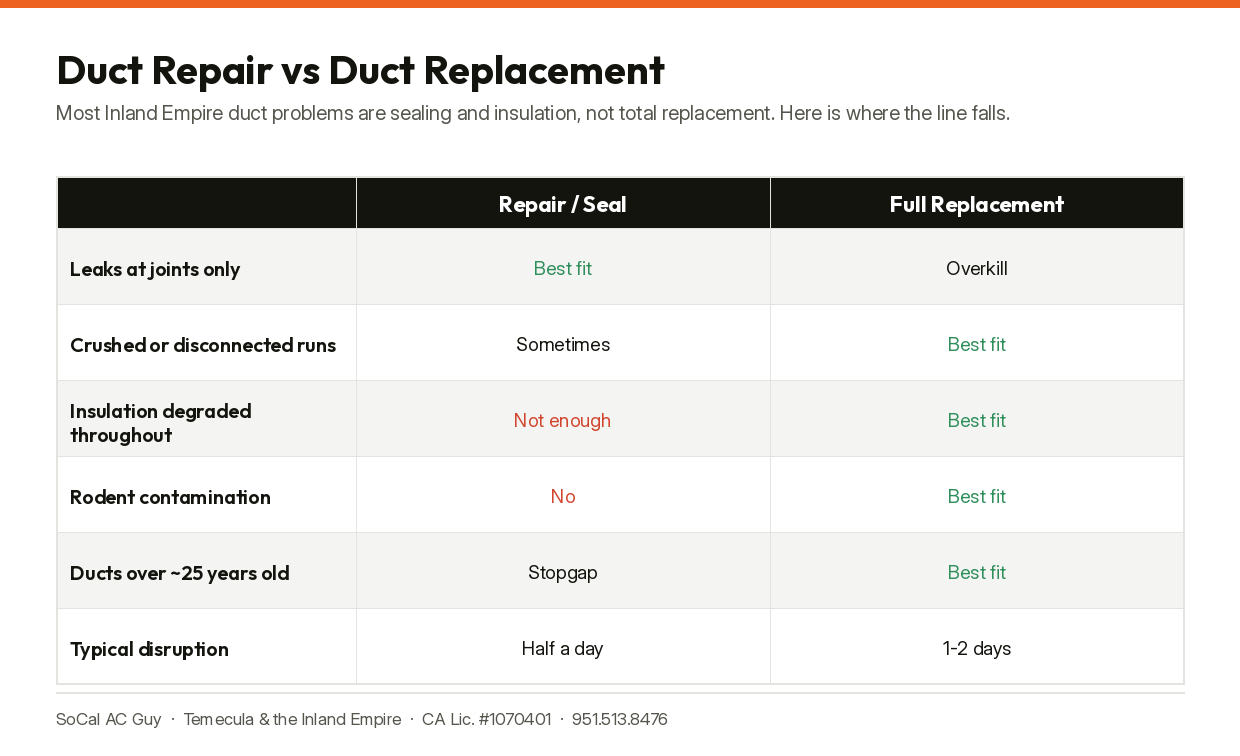
Ductwork is the part of an HVAC system nobody thinks about until something goes wrong. Then they think about it constantly — high bills, hot bedrooms, cold front rooms, dust everywhere, weird whistling sounds, the AC running forever and never cooling the upstairs. Most of those symptoms trace back to duct problems, not the AC. And the repair-vs-replacement decision usually isn’t black and white — it’s “what’s the cheapest path to a system that actually performs?”
I’m Jorge — owner of SoCal AC Guy (CA Lic. #1070401), C-20 HVAC. I run duct inspections every week across Temecula, Murrieta, Menifee, and the surrounding Inland Empire. This guide is the same decision framework I use on every estimate — what to repair, what to seal, what to replace, what 2026 pricing looks like, and the warning signs that mean repair is throwing good money after bad.
The duct system carries conditioned air from your air handler to every room, and pulls warm or cold air back through the return path. Sounds simple. In practice, it’s a network of trunk lines, branch lines, flex sections, plenums, dampers, register boots, and return drops — usually buried in attics where it bakes at 130–150°F in July. Roughly 20–30% of conditioned air in a typical Inland Empire home is lost to leaks, gaps, and disconnections before it ever reaches a room. Title 24 (California’s energy code) caps allowable duct leakage at 5% of total system airflow for new construction; many existing IE homes are running 25–45%.
When the master bedroom or upstairs bonus room is consistently 6–10°F warmer than the living room, the duct branch serving that room is either undersized, kinked, partially disconnected, or full of leaks losing supply air to the attic. This is the #1 duct symptom I see in Temecula and Murrieta tract homes with long second-story duct runs.
If your AC is sized correctly and the refrigerant charge is right, but the house just won’t get cold, you’re often paying to cool the attic. Heavy leakage in the supply trunk dumps 55–58°F supply air directly into 140°F attic space. The system runs forever because the rooms never get the cool air they need.
A duct system losing 30% of conditioned air costs roughly 30% more to run for the same comfort. Sealing leaks typically reduces summer cooling kWh consumption 12–25% in IE homes, which on SCE TOU rates can be $40–$120 per peak-summer month.
If you’re wiping dust off surfaces every two days, your return duct system is probably pulling unfiltered attic air through gaps and pulling dust into the conditioned envelope. Test: the dust should be heaviest near return grilles. If it is, the return system is leaking.
Whistling at registers means high static pressure — usually undersized return ducts, restricted filter, or crushed flex duct somewhere. Hissing from attic spaces is air escaping a torn duct or a failed connection. A loud “thump” at startup is a section of flex duct that’s pressurizing and shifting against framing.
If you can pull yourself into the attic safely, look for flex duct that’s sagging into the insulation, drooping into a “U” between joists, or completely disconnected at a register boot. After 15–20 years of IE attic heat, flex duct outer jackets crack, the inner liner separates, and connections slip.
If kitchen cooking smells show up in the master bedroom 5 minutes later, or shower humidity hits the living room thermostat, the return system is moving air it shouldn’t be — often through gaps in the return drop or a leaky return plenum.
Before deciding repair vs replace, you have to know what you’re working with. Most IE homes have one of three duct types, and each has different repair viability.
Most common in Inland Empire homes built 1990–present. A coiled wire spring inside a Mylar-or-vinyl inner liner, wrapped in fiberglass insulation, jacketed in a vapor barrier. Typical lifespan: 10–20 years in attic conditions. Easy to repair small tears with mastic-and-mesh patches. Easy to extend with new branches. When flex needs full replacement: when more than 30–40% of branches show damage, when the inner liner is collapsed or torn in multiple places, or when the duct system was undersized at original install and can’t be fixed by patching.
Common in 1970s–1990s tract homes in Menifee, older parts of Sun City, and Riverside County in general. Lifespan up to 25 years. Sealable at every seam with mastic. The most repairable duct material on the market — a full reseal of an aging sheet metal system can restore it to near-new performance for a fraction of replacement cost. When sheet metal needs full replacement: rust-through, asbestos wrap insulation (common pre-1980), severe acoustic problems from undersized design, or when ceiling/wall demolition is happening anyway for other reasons.
Less common in residential IE but you’ll see it on packaged-unit installs and some 1980s–1990s tract builds. Typical lifespan: 15–20 years before the fiberglass starts degrading and shedding. When duct board needs replacement: visible inner-surface degradation (the gray cardboard-like surface flaking), water damage, sagging, or any indoor air quality concern. Duct board past its prime is not worth repairing — replace the trunk in sheet metal.
| Service | Typical IE Price (2026) | When It Makes Sense |
|---|---|---|
| Single duct leak repair | $185–$385 | Isolated tear, accessible location |
| Multi-leak seal job (mastic system-wide) | $385–$845 | Sheet metal, multiple small leaks |
| Aeroseal (interior spray seal) | $1,650–$2,800 | Sheet metal, many small leaks, inaccessible |
| Single branch replacement (flex) | $285–$485 per branch | One bad branch, others good |
| Partial duct replacement (3–5 branches) | $1,200–$2,400 | Some branches good, some need replacement |
| Full duct replacement (1,500–2,200 sq ft home) | $2,400–$4,800 | System-wide failure, undersized original |
| Full duct replacement (2,200–3,200 sq ft home) | $4,200–$7,200 | Larger home, multi-zone, 2-story |
| Title 24 duct leakage test (post-install) | $285–$485 | Required after any major duct work |
Two notes on this pricing. First, Inland Empire labor is roughly 10–15% lower than coastal Orange County and L.A. metro, but Riverside County permit fees push some numbers back up. Second, any duct work that touches more than 40 linear feet triggers California Title 24 duct leakage testing requirements — budget for the test and the small re-seal that’s almost always needed to pass.
I’ll crawl the attic, inspect every accessible branch, measure static pressure at the air handler, check return sizing, and identify what’s actually causing your comfort or efficiency problems. You’ll get an itemized estimate with three options — targeted repair, partial replacement, full replacement — and the honest read on which one solves your problem.
After enough duct jobs, the decision tree compresses to a handful of rules. Here’s what runs through my head on a typical inspection.
The duct material is in good shape overall, leaks are localized, the system is correctly sized, and accessibility is reasonable. Sheet metal trunk systems are almost always worth sealing rather than replacing — mastic-and-mesh at every seam can drop measured leakage from 30%+ to under 8% for $400–$900 in a typical single-story home. Flex branch systems with 1–3 damaged branches are typically worth one-off branch replacement at $285–$485 each.
You have a sheet metal or duct board system with many small leaks scattered throughout, and physical access is difficult (low-clearance attic, tight crawlspace, ceiling-buried sections). Aeroseal pressurizes the duct system and sprays a polymer aerosol that finds and plugs leaks from the inside. Pricier ($1,650–$2,800) but reaches places mastic can’t. Works best on rigid duct; less effective on flex.
When repair cost is approaching 50% of replacement cost. When the system was undersized at original install — no amount of patching fixes a duct that’s 6″ where it needed to be 8″. When the inner liner of flex duct is degraded or collapsed across most branches. When asbestos wrap or duct board is shedding. When you’re already replacing the AC and the duct system is 15+ years old — combining the jobs saves labor and gets you a properly matched system. When you’re remodeling and ceilings are already open.
Asbestos-wrapped duct (pre-1980 sheet metal in some IE homes — requires licensed abatement, then replacement). Rusted-through metal trunks. Mold-contaminated duct interior. Rodent-damaged duct with significant chewing or nesting. Any duct that’s been wet for an extended period from a roof leak or condensate failure.
If you’re already past 12–14 years on the AC and the duct system is similar age, the combined replacement is usually the better economic call. Three reasons:
1. Sizing match. A 14-year-old duct system was likely sized for the 10 SEER equipment of that era. Modern 16–20 SEER2 systems have different airflow requirements, often need bigger return drops, and benefit from properly sized supply trunks. Pairing new high-efficiency equipment with tired old ducts loses 15–25% of the efficiency you paid for.
2. Labor consolidation. Air handler removal, attic access, electrical and refrigerant disconnections all overlap. Doing both jobs together saves $400–$900 in duplicated labor.
3. Title 24 compliance. California requires post-install duct leakage testing on any major HVAC change-out. If your existing ducts won’t pass — common on aged systems — you’re going to do duct work either way, just in a worse order. Plan it together. See How to Size an AC for Your Inland Empire Home and Best AC Brands for Southern California 2026 for the equipment-side decisions.
If your “duct estimate” took 10 minutes and the tech never went in the attic, that’s not an inspection — that’s a sales call. A real one takes 45–75 minutes and includes:
Visual attic walkthrough of every accessible branch, photographing tears, disconnections, and crushed runs. Static pressure measurement at the air handler (supply and return side) — high static pressure is the canary for restricted ducts, undersized returns, or kinked flex. Supply temperature reading at each register, looking for branches that aren’t getting their share of airflow. Return system inspection — gaps at the return drop, leaky return plenums, and unsealed filter boxes are responsible for the majority of “we have dust everywhere” complaints. Optional duct blaster test for measured total leakage in CFM at 25 Pa (required by Title 24 after major work).
Full duct replacement runs $2,400–$4,800 for a typical 1,500–2,200 sq ft Inland Empire single-story home, and $4,200–$7,200 for a 2,200–3,200 sq ft two-story. Pricing includes new flex or sheet metal supply lines, new return drops, all sealing, and Title 24 duct leakage testing. Permits typically add $185–$385 depending on jurisdiction.
Often, yes — particularly on sheet metal trunk-and-branch systems. Mastic-and-mesh sealing at every seam typically costs $385–$845 and can drop total duct leakage from 25–40% to under 8%. Sealing makes the most sense when the duct material is structurally sound, leaks are at joints rather than holes in the walls of the ducts themselves, and the system was properly sized at install. Sealing doesn’t fix undersized ductwork or collapsed flex liner.
Flex duct in IE attic conditions (130–150°F sustained summer temperatures) typically lasts 10–20 years. Sheet metal lasts 20–25 years and can be sealed and restored well past that. Duct board lasts 15–20 years before fiberglass degradation becomes a concern. The duct system is generally tougher than the AC equipment — you’ll likely go through two AC change-outs before you absolutely have to replace ducts.
Yes, measurably. A duct system going from 30% leakage to under 8% leakage typically reduces summer cooling kWh consumption by 12–25%. On a typical IE single-family home with $250–$400 peak-summer SCE bills, that’s $40–$120 in monthly savings during the 4–5 hottest months. Annualized, $200–$500 in savings — before counting the comfort improvement.
For minor repairs (single branch, single seal job under 40 linear feet of duct touched), typically no. For partial or full duct replacement and any work that triggers Title 24 duct leakage testing, yes — permit requirements apply across Temecula, Murrieta, Menifee, and unincorporated Riverside County. Permits run $185–$385 and include a final inspection. A licensed C-20 HVAC contractor pulls the permit for you.
Mastic is a thick paste applied by hand at every accessible seam — the traditional method. Cheaper ($385–$845) and reaches everything you can physically touch. Aeroseal is a polymer aerosol that’s blown into a pressurized duct system, finding and plugging small leaks from the inside — reaches places hands can’t. Pricier ($1,650–$2,800) but the better option when access is limited or leaks are scattered. The two methods are often combined: mastic the accessible big leaks, Aeroseal the rest.
SoCal AC Guy inspects, repairs, seals, and replaces ductwork across Temecula, Murrieta, Menifee, Wildomar, Lake Elsinore, Winchester, Sun City, Canyon Lake, French Valley, La Cresta, and De Luz — plus the broader Riverside County and North San Diego County service area.
Jorge — C-20 HVAC, CA Lic. #1070401. Real attic walkthroughs, static pressure measurements, leak identification, and three-option estimates (seal / partial / full replacement) on every job. 10+ years across the Inland Empire. Title 24 testing included.
Call (951) 513-8476
Get a Free Estimate
Author: Jorge the AC Guy • C-20 HVAC • CA Lic. #1070401
Other guides that answer the questions this one usually raises: