
The honest answer for Temecula, Murrieta, and Menifee homeowners: 10–15 years — not the 15–20 the national charts quote. Triple-digit summers, 2,500+ annual runtime hours, dry desert wind, and dust drive faster wear here than almost anywhere else in California. Here’s what actually shortens the life of your system, and what extends it.
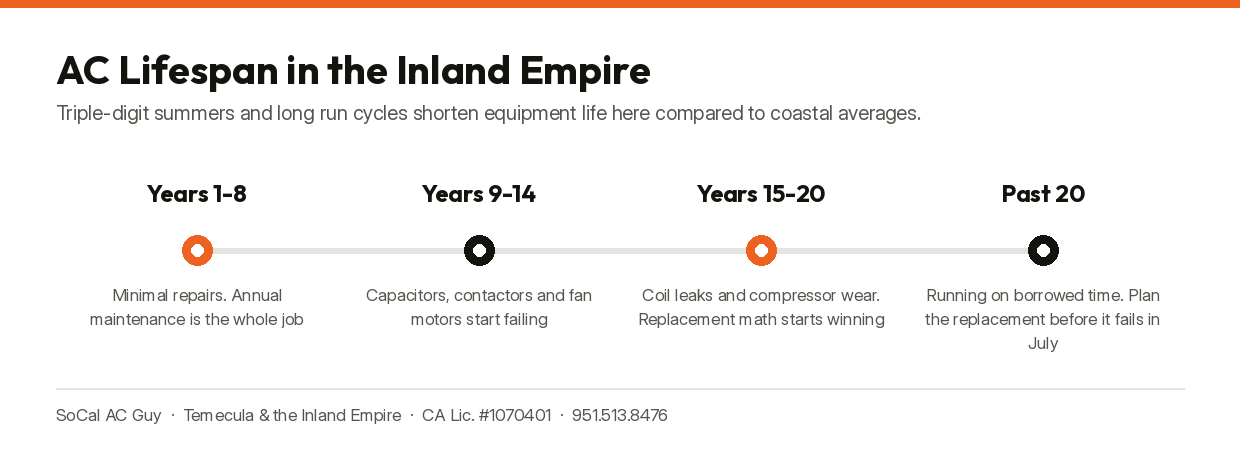
When the manufacturer’s brochure says “expected service life: 15 to 20 years,” that number is calibrated for a moderate climate — think Sacramento, coastal San Diego, or really anywhere the AC runs maybe 1,000–1,500 hours a year. The Inland Empire is not that climate. Out here, AC runtime routinely hits 2,500–3,500 hours annually because the cooling season runs from late March through November — an eight-month marathon. That extra runtime, plus the dry desert wind, dust, occasional wildfire smoke, and triple-digit afternoons, cuts realistic lifespan to 10–15 years for a well-maintained system, and 8–10 years for a neglected one.
I’m Jorge — owner of SoCal AC Guy (CA Lic. #1070401), C-20 HVAC. I see the same lifecycle play out across hundreds of homes in Temecula, Murrieta, Menifee, and the surrounding service area. This guide covers what actually drives AC lifespan in our climate, the warning signs that you’re approaching the replace decision, and the maintenance moves that have a real effect on the calendar.
Five factors converge to compress the lifespan curve here, and none of them are going away.
A compressor is rated for a finite number of operating hours, not calendar years. National lifespan numbers assume 1,000–1,500 runtime hours per year. Temecula systems average 2,500–3,500 hours. A 12-year-old IE system has put in roughly the same hours as a 20-year-old Bay Area system. The compressor, capacitor, contactor, and blower motor all see proportionally more wear.
When the outdoor air is 108°F, the condenser coil has to reject heat into already-hot air. That pushes head pressure (the high side of the refrigerant loop) into the 400+ psi range routinely. Sustained high head pressure accelerates compressor valve wear, hardens the lubricant in the compressor oil, and stresses copper braze joints. This is the single biggest reason IE systems age faster.
The condenser coil is a fine-fin aluminum heat exchanger. Fill the gaps with dust, dry grass clippings, dog hair, or wildfire ash, and the coil’s ability to reject heat drops — which raises head pressure again, and accelerates wear in the loop above. Inland Empire backyards collect debris fast. A coil that hasn’t been rinsed in two years can lose 15–30% of its heat-rejection capacity.
A few times a year, the Santa Anas drive desert dust, palm-frond debris, and tumbleweed fragments directly into condenser cabinets. After a serious wind event, fan blades can be off-balance, coil fins flattened, and electrical compartments full of grit. Most homeowners don’t inspect after Santa Anas, and that damage compounds. See our Santa Ana Wind HVAC Checklist for the post-event walkthrough.
SCE’s TOU-D-4-9PM and TOU-D-PRIME rate plans charge peak rates 4–9 p.m. That’s also the hottest part of the IE day. Households that fight the heat by running aggressive setpoints during peak hours stack the most expensive electricity onto the highest mechanical stress — bills go up, and so does compressor wear. Smart thermostat pre-cooling (covered in our Smart Thermostats in the Inland Empire guide) helps with both.
| System Type | National Average | Inland Empire (well-maintained) | Inland Empire (neglected) |
|---|---|---|---|
| Central AC (split system) | 15–20 years | 12–15 years | 8–10 years |
| Heat pump | 12–15 years | 10–13 years | 7–9 years |
| Ductless mini-split | 15–20 years | 12–17 years | 10–12 years |
| Furnace (gas, 80–95% AFUE) | 15–20 years | 18–22 years | 12–15 years |
| Packaged unit (rooftop) | 12–15 years | 10–12 years | 7–9 years |
Two patterns worth noting: furnaces actually run longer here than the national average because they barely cycle — Temecula winters demand maybe 200–400 hours of heat per year. And mini-splits, despite the heat, tend to outlast central systems because variable-speed inverter compressors run at part load most of the time, which is gentler than the on/off slam-cycling of a single-stage central system.
Aging AC systems telegraph their decline well before they catastrophically fail. If you’re seeing several of these at once, start budgeting and pricing now — not in August when the compressor finally quits at 4 p.m. on a 107°F Tuesday and every IE HVAC company has a four-day backlog.
Five years ago, the AC pulled the house from 84°F to 76°F in 25 minutes. Now it takes 45. This is usually a combination of declining compressor capacity, refrigerant charge drift, and a dirty condenser coil. Sometimes maintainable, often not.
When kWh consumption climbs 8–15% per year despite identical setpoints and household behavior, that’s the system getting less efficient. SEER ratings on aging equipment can drift 20–30% below nameplate before failure.
Capacitor in May, contactor in June, refrigerant top-off in July. Aging components fail together because they’ve all seen the same hours. The $200–$400 repair calls add up — and the compressor (the $1,800–$2,800 part) is usually next.
If your AC is 13+ years old, there’s a real chance it uses R-22 (Freon), which was phased out for new equipment in 2010 and is now reclaimed-only at $90–$150 per pound. A 5 lb top-off costs $450–$750 in refrigerant alone. Any meaningful repair on an R-22 system pushes the math hard toward replacement. The current refrigerant standard is R-454B (2025 cutover) — see our R-454B Refrigerant Transition guide for what that means for new installs.
If the master bedroom or second story is now consistently 5–8°F warmer than the living room and that’s new, the system is losing its ability to push enough air through the longest duct runs. Often this is a duct or sizing problem rather than the AC itself — see our Ductwork Repair vs Replacement guide — but it can also signal a tired blower motor or low refrigerant.
Grinding, screeching, hard-start clicks, or a low-frequency vibration that wasn’t there last year. Aging contactors arc, aging compressors struggle to start under load, and aging blower bearings get loud. Detail in our Strange AC Noises Explained guide.
Surface rust on the outdoor cabinet is cosmetic. Rust at the suction line, at brazed copper joints, or in the condensate pan is structural — refrigerant or water leaks are imminent or already happening.
The compressor kicks on, runs for 60–120 seconds, kicks off, then restarts a few minutes later. This is usually a failing capacitor, a control board issue, or a compressor that’s losing the ability to sustain compression. Short-cycling cooks compressors fast — address it within days, not weeks.
If your system is 10+ years old and acting up, I’ll run a system health check — refrigerant charge, capacitor microfarad reading, amp draw across compressor and blower, supply/return temperature split, condenser coil condition, and ductwork pressure test. You’ll get an itemized read on what’s left in the system and a real repair-vs-replace recommendation. No commission, no upsell.
Maintenance literature is full of advice that’s true in moderate climates and mostly irrelevant out here. The five items below are the ones that move the needle in the Inland Empire specifically.
Not optional. A pre-summer tune-up catches a marginal capacitor before it strands you in 105°F weather, flags refrigerant charge drift before head pressure damages the compressor, and gives the condenser coil a real chemical clean (not just a garden hose rinse). Walkthrough in our Pre-Summer AC Tune-Up Checklist. A $129–$189 tune-up that catches one early-stage problem pays for itself five times over.
A loaded filter chokes return airflow, drops evaporator coil temperature, and in extreme cases freezes the coil (see Frozen AC Coil). Stick to MERV 8–11 for standard residential systems — MERV 13+ is great for IAQ but adds static pressure that older blowers can struggle with. During wildfire smoke days, swap more often.
2 feet of clearance on all sides, 5 feet of vertical clearance. No bougainvillea or oleander touching the unit. If the condenser is on a west or south wall taking direct 4–7 p.m. sun, a shade structure (not enclosure — airflow has to stay open) can drop head pressure 5–10% during peak heat. Trex panel shade, lattice with afternoon clearance, or a covered patio extension all work.
Pre-cooling from 1–4 p.m. (off-peak) lets the home coast on stored thermal mass during 4–9 p.m. (peak). Result: 25–35% fewer peak runtime hours per summer, which translates directly to compressor life. Configure this in any smart thermostat (Nest, Ecobee, Honeywell T6/T10). The dollar savings are real; the equipment-life savings are arguably bigger.
An oversized AC short-cycles — lots of starts, brief runs, never settling into steady-state. That’s the single most damaging operating mode. An undersized AC runs continuously and never satisfies the thermostat, which is also damaging plus uncomfortable. A correctly sized system (within 5–10% of calculated load) runs longer cycles at part load, dehumidifies properly, and lasts longer. See How to Size an AC for Your Inland Empire Home for the underlying calculation.
A reasonable rule for IE systems: when the cost of a single repair exceeds 30–40% of replacement cost on a system that’s already 10+ years old, replace. When repair costs in the previous 24 months exceed 50% of replacement cost, replace regardless of age. When you’re on R-22, almost any major repair triggers replacement. Detail on full-system pricing in our 2026 HVAC System Cost Guide and on compressor specifics in AC Compressor Replacement — Repair or Replace?
One more factor specific to 2026: with the federal 25C tax credit eliminated as of January 1, 2026, and TECH Clean California single-family heat pump rebates fully reserved as of late February 2026, the rebate stack on new installs is the thinnest it’s been in three years. SCE still has $200–$1,000 utility rebates on qualifying high-efficiency systems, and SoCalGas has $150–$500 furnace rebates, but the federal cushion is gone. That doesn’t change the lifespan math, but it does change the financing math — verify current rebate status at sce.com and socalgas.com before signing.
Years 1–5: Honeymoon. Annual tune-ups, filter changes, occasional condensate line flush. Total upkeep cost: $150–$250 per year. No major repairs expected.
Years 6–10: First wear items appear. Capacitor replacement ($175–$285) is the most common — capacitors are basically wear-out items in IE heat. Possibly a contactor ($165–$245), possibly a condensate pump on horizontal air handler installs. Annual cost trends $200–$450.
Years 11–14: Replace-or-repair territory. Refrigerant leaks become more likely. Blower motors and fan motors start to fail. Efficiency has declined noticeably. Annual cost can swing $300–$800 in repair years. Start budgeting for replacement.
Year 15+: Living on borrowed time. Compressor failure becomes the dominant risk. Even on a well-maintained system, replacement is usually the right financial call — the older the equipment, the worse the part-and-labor-to-value ratio for any major repair.
A well-maintained central AC in Temecula or the broader Inland Empire typically lasts 12–15 years, with high outliers reaching 18. Neglected systems often fail at 8–10 years. The national average of 15–20 years doesn’t apply here — 2,500+ annual runtime hours, sustained triple-digit heat, and dust loading all compress the lifespan curve.
It’s possible but rare. The combination of religious annual maintenance, proper sizing, condenser shading from afternoon sun, SCE TOU pre-cooling instead of brute-force peak runtime, a quality high-SEER variable-speed system, and a bit of luck can push lifespan past 18 years. A standard single-stage system in a sun-exposed install with average maintenance is realistically a 12–14 year unit.
Rule of thumb: if your system is 10+ years old and the single repair exceeds 30–40% of replacement cost, replace. If your system is on R-22 refrigerant, almost any meaningful repair pushes toward replacement because R-22 now runs $90–$150 per pound. If you’ve spent more than half the replacement cost in repairs over the past 24 months, replace regardless of age.
During peak summer in the Inland Empire (90–110°F days), a correctly sized AC can run 60–80% of the day to maintain setpoint — that’s normal. What’s not normal: running continuously without ever satisfying the thermostat, or running noticeably longer this year than last year for the same indoor temperature. The first usually indicates an undersized or failing system; the second indicates declining efficiency, low refrigerant, or a dirty condenser.
Yes — measurably. A documented annual tune-up record correlates with 15–30% longer service life on central AC systems in hot-dry climates. The mechanism is straightforward: tune-ups catch low refrigerant, marginal capacitors, dirty condenser coils, and incorrect static pressure before those conditions cause cascading damage. A $150–$200 tune-up that prevents a single $450 capacitor-and-fan-motor cascade has already paid for itself.
Generally more reliable, with one caveat. Modern 16–20 SEER2 variable-speed inverter systems (Carrier Infinity, Trane XV, Lennox SL, Mitsubishi Electric mini-splits) run at part load most of the time, which is gentler on the compressor than the on/off cycling of a single-stage system. The caveat: variable-speed control boards are more expensive when they fail ($600–$1,400 versus $200–$400 for standard board), so when something does break, the part cost is higher.
SoCal AC Guy services Temecula, Murrieta, Menifee, Wildomar, Lake Elsinore, Winchester, Sun City, Canyon Lake, French Valley, La Cresta, and De Luz — plus the broader Riverside County and North San Diego County service area.
Jorge — C-20 HVAC, CA Lic. #1070401. Honest system health checks across the Inland Empire. Real numbers on refrigerant charge, amp draw, capacitor health, coil condition, and supply/return temperature split. You’ll get a clear repair-or-replace read with no commission pressure. 10+ years local.
Call (951) 513-8476
Get a Free Estimate
Author: Jorge the AC Guy • C-20 HVAC • CA Lic. #1070401
Other guides that answer the questions this one usually raises: