
A licensed C-20 HVAC contractor’s honest breakdown of single-stage, two-stage, and variable-speed air conditioners — what each one actually does, what the upcharge buys you in 110°F Inland Empire summers, and which one I’d put in my own home in 2026.
Every quote I write for a homeowner in Temecula, Murrieta, or Menifee ends up with the same fork in the road. There’s a $7,000 single-stage option, a $10,000 two-stage option, and a $13,000–$15,000 variable-speed option. Same square footage, same brand catalog, three very different prices. The salesperson before me told them the variable-speed is “way more efficient” and left it at that. The homeowner wants to know if it’s actually worth the extra $5,000.
I’m Jorge — owner of SoCal AC Guy, CA Lic. #1070401, C-20 HVAC. I’ve installed all three types across the Inland Empire for more than a decade. The honest answer isn’t “always variable-speed” or “always single-stage” — it depends on your house, your duct system, your run time, your power bills, and how long you’re going to live there. This guide walks through every variable I’d weigh before signing the contract, with real numbers from 2026 jobs in the Temecula Valley.
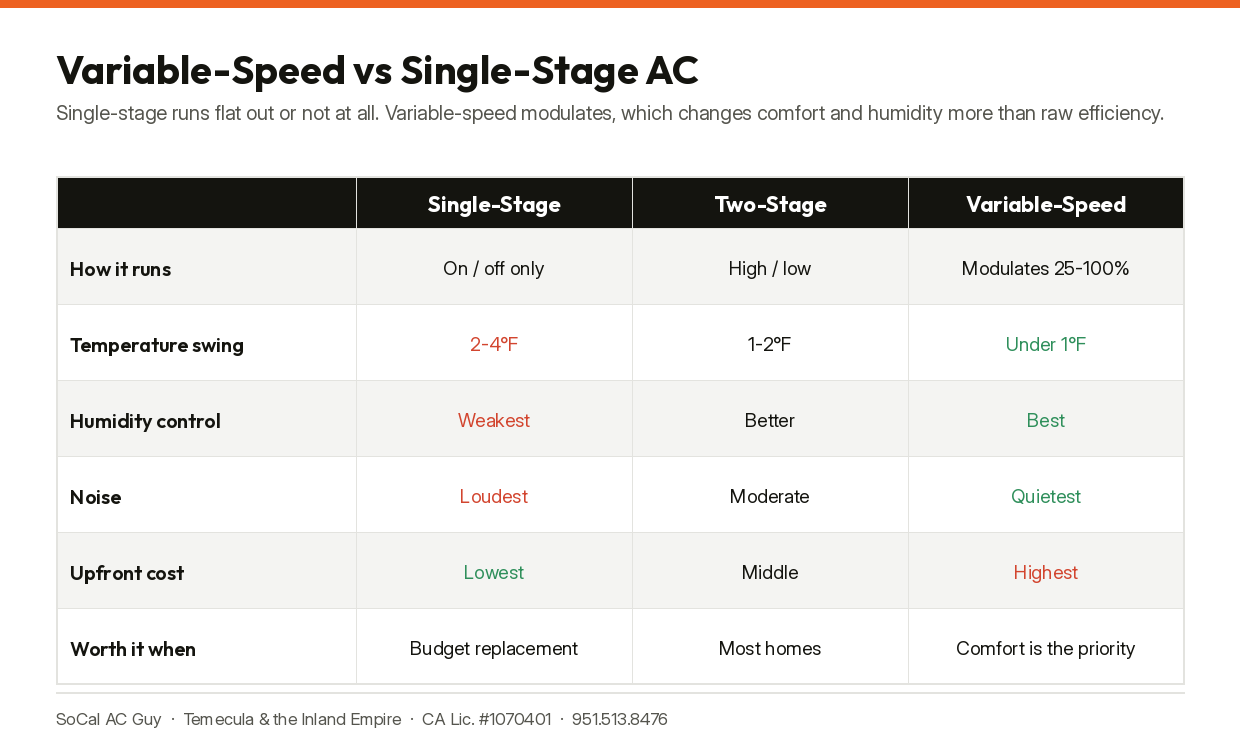
An air conditioner has a compressor — the heart of the system, the thing that does the work. The “stage” or “speed” rating describes how many output levels that compressor can run at. That single design choice cascades through everything else: efficiency, comfort, humidity control, noise, and price.
Single-stage: the compressor is either 100% on or fully off. That’s it. When the thermostat calls for cooling, the unit ramps to full output, runs until the setpoint is hit, then shuts off completely. It cycles like a light switch.
Two-stage: the compressor has a low stage (roughly 65–70% capacity) and a high stage (100%). It runs on low most of the time and steps up to high when the load demands it — usually the hottest part of the afternoon. The result is longer, gentler run cycles and more even temperatures room to room.
Variable-speed (also called variable-capacity or inverter-driven): the compressor can modulate anywhere from roughly 25% to 100% of capacity in small steps, often dozens of discrete output levels. On a moderate day in Temecula, the unit might run at 30% all afternoon, never cycling off, drawing a fraction of the power a single-stage would burn pulse-by-pulse.
Pricing varies with brand, tonnage, and the condition of the existing duct system, but here are the ranges I see most weeks across a 3-ton split system in the Temecula Valley with the new R-454B equipment that became mandatory January 1, 2026:
| Compressor Type | Typical SEER2 Range | Installed Price (3-ton, R-454B) | Estimated 15-Yr Energy Cost |
|---|---|---|---|
| Single-stage | 14.3 – 15.5 | $6,800 – $9,500 | $23,000 – $28,000 |
| Two-stage | 16 – 18 | $9,500 – $12,500 | $18,500 – $22,500 |
| Variable-speed | 18 – 28 | $12,500 – $19,500+ | $13,500 – $18,000 |
Energy cost projections assume a 2,200 sq ft Temecula home, SCE rates trending at 35¢/kWh blended, 1,400 cooling hours/year, and 3% annual rate escalation. Excludes any electrical or duct upgrades. Compare against New HVAC System Cost in Temecula and Best AC Brands for Southern California in 2026.
Here’s where the math gets interesting for our local climate. The Temecula Valley logs roughly 110–130 days a year where the outdoor temperature exceeds 90°F, and a typical summer day in Lake Elsinore or Winchester sees the AC running 8–14 hours. That’s an enormous annual run-time compared to coastal homes — and run-time is where variable-speed systems print money back over their lifespan.
A single-stage system in Temecula cycles on and off something like 30–60 times a day in peak summer. Every start-up draws a large inrush of current (the “locked rotor amps” hit) and runs for 8–15 minutes before satisfying the thermostat. The thermal comfort experience is uneven: warmish, then a cold blast, then warmish again. The humidity rises during the off-cycle and gets dumped during the on-cycle.
A variable-speed system in the same house, sized correctly, might run continuously at 30–40% capacity from 11am to 8pm without ever cycling. Air keeps moving. Temperatures stay flat to within a degree. The compressor never sees a hard inrush after startup. And because the system is sipping power instead of gulping it in slugs, the kilowatt-hour bill drops 25–40% during cooling-dominant months on most of the homes I’ve measured.
That math doesn’t work the same way for a vacation home in Anza that runs the AC three weekends a summer. It works powerfully for a primary residence that’s cooling 12 hours a day, 100 days a year.
An air conditioner does two jobs: cools the air (sensible cooling) and pulls moisture out of the air (latent cooling). Latent cooling only happens when the indoor coil is cold enough for water to condense on it, which only happens when the system is running. Short single-stage cycles mean less latent removal, which is why a single-stage AC in a humid month can leave a house feeling clammy at the thermostat setpoint even though the temperature is technically correct.
Most of the year the Inland Empire is dry, so latent cooling isn’t a top concern. But during the summer monsoon weeks in July and August when desert moisture surges in, indoor humidity in Menifee and Sun City homes can climb into the high 50s. That’s where two-stage and variable-speed pull ahead noticeably. The longer run-times pull more water out. The home feels cooler at a higher thermostat setting because lower humidity reads as comfort. I’ve had clients dial the setpoint up 2°F after a variable-speed install and report better comfort with lower bills.
I won’t tell you variable-speed is always the right answer. There are real scenarios where single-stage equipment is the smart pick:
You’re selling the house in under 5 years. The payback period on a variable-speed upcharge in our climate runs roughly 6–9 years. Selling sooner means you pay the upcharge and never recoup it. Buyers won’t pay you a $5,000 premium at closing for the variable-speed badge.
It’s a rental property. Tenants pay the electric bill, not the owner. The owner sees zero direct return on the efficiency upcharge. A reliable single-stage Goodman is the right rental answer almost every time.
The duct system is undersized or leaky. A variable-speed system needs a duct system that can move air at low static pressure. If your existing ductwork is a 1990s tract-home mess of crushed flex and undersized returns, the variable-speed compressor will spend its life fighting back-pressure and never deliver the comfort the marketing brochure promised. Fix the ducts first or pick a tougher single-stage system. See Ductwork Repair vs Replacement.
You’re on a tight cash budget and 0% financing isn’t available. A working single-stage system is dramatically better than a delayed variable-speed system. Don’t go into debt on a comfort upgrade if it strains the household.
Two-stage systems are the middle path I recommend on a lot of Temecula tract homes. Roughly $2,500–$3,500 over a single-stage, with most of the comfort benefit of variable-speed and a more forgiving install profile. Two-stage compressors don’t require the same level of duct-system precision that variable-speed does. They tolerate marginal duct conditions better. They cost less to repair post-warranty because they use simpler control boards.
If a homeowner is on the fence between single-stage and variable-speed, I often steer them to two-stage. Two-stage equipment from Carrier (Performance series), Trane (XR16), Lennox (EL16XC1), Goodman (GSXC18), and Daikin (DX17VSS) is mature, widely stocked, and reliable. You get long run-times, better humidity control, real efficiency gains, and avoid the variable-speed price premium and the inverter-board failure risk down the road.
Variable-speed is the right answer when several of these conditions stack up:
You’re staying in the home long-term. You run the AC heavily — afternoons and evenings May through October. Your electric bills already exceed $350 in peak summer months. You have a two-story home with persistent upstairs heat gain (variable-speed paired with proper zoning solves this better than any other approach). You care about indoor noise levels — a modulating compressor at 35% capacity is genuinely whisper-quiet at the outdoor condenser, often under 60 dB. You have a custom or high-end home where the comfort and aesthetic standards justify the upcharge — common in Canyon Lake, Temecula wine country, and the La Cresta estate areas. Or you’re combining the AC swap with a heat pump conversion to electrify the home — variable-speed heat pumps from Mitsubishi, Daikin, Carrier, and Trane handle the Temecula winter shoulder season much better than single-stage heat pumps.
For the deeper picture on heat pump suitability, see Heat Pump in Cold Weather: Do They Really Work in Temecula Winters? and Heat Pump Installation Cost in the Inland Empire.
Here’s the part no one tells you when they’re trying to sell up: a variable-speed system that’s oversized performs almost identically to a single-stage system. The reason is simple — if the smallest stage of the modulating compressor is still bigger than the house’s actual cooling load, the system will short-cycle on minimum just like a single-stage would.
I see this all the time on resales. The previous owner had a “high-end” variable-speed system installed by a contractor who rule-of-thumbed the tonnage instead of running a Manual J load calculation. The 3.5-ton variable-speed in a 1,800 sq ft tract home is wildly oversized. It modulates between 30% (which is still 1.05 tons, more than the load on most spring days) and full capacity, and effectively never holds a steady low-speed run. The homeowner paid the variable-speed premium and is getting single-stage performance.
If you’re putting a variable-speed system in, the Manual J load calc isn’t optional — it’s the entire point. See How to Size an AC for Your Inland Empire Home (Manual J Explained) for the full sizing methodology.
A piece of bad news first: the federal 25C Energy Efficient Home Improvement Credit — the up-to-$2,000 credit for qualifying heat pumps — was eliminated by the One Big Beautiful Bill Act signed in July 2025. Per current IRS guidance, the credit is not available for property placed in service after December 31, 2025. For 2026 installs, the federal tax credit is zero. Anyone telling you they’ll “get you the $2,000 tax credit” on a 2026 quote either hasn’t read the legislation or is misrepresenting it.
What’s still available: SCE utility rebates ranging $200–$1,000 for qualifying central AC and heat pump installs that hit minimum efficiency thresholds. SoCalGas rebates on qualifying gas furnaces and dual-fuel systems. GoGreen Home Energy Financing for income-qualifying homeowners with attractive APRs. The HEEHRA program (federal IRA-funded California rebates for low-to-moderate-income households) ran out of funding for new applications in February 2026. For a complete and current list, see Every HVAC Rebate Available in Riverside County in 2026.
For most homeowners I quote in the Temecula Valley — primary residence, 1,800–2,800 sq ft, planning to stay 7+ years, blended SCE rate around 35¢/kWh, running AC heavily May through October — the right answer is usually a properly sized two-stage system from Carrier, Trane, Lennox, Goodman, or Daikin paired with a variable-speed air handler. That combination captures roughly 70% of the comfort and efficiency upside of a full variable-speed system at about 60–70% of the cost.
For a custom or higher-end home with strong ductwork, a long ownership horizon, two stories, and the budget to do it right, I’d go variable-speed every time — Carrier Infinity, Trane XV20i, Lennox SL line, or Daikin DX20VC. The comfort and bill difference is real.
For a rental, a sub-5-year ownership horizon, or a tight budget, a properly sized single-stage system is not a downgrade. It’s the right tool for the job. Pick a brand with a strong compressor warranty (Goodman GSXC, Carrier Performance, or Trane XR series) and put the savings into duct sealing and a good filter cabinet.
I’ll come out, run a Manual J load calc, and price your job three ways — single-stage, two-stage, and variable-speed — with the projected energy savings written next to each. You see the math, you pick the tier. Free, no pressure.
For a primary residence with heavy AC run-time (May through October), long ownership horizon (7+ years), and a duct system that’s in decent shape — yes, the math usually works out. The payback period on the upcharge runs 6–9 years from energy savings alone, with comfort and humidity benefits on top. For rentals, sub-5-year ownership, or marginal duct conditions, a two-stage or single-stage system is usually the smarter buy.
In the Temecula Valley in 2026, expect to pay roughly $4,000–$8,000 more for a variable-speed system than a comparable single-stage from the same brand. Two-stage falls in the middle, typically $2,500–$3,500 over single-stage. Exact pricing varies with brand, tonnage, and duct condition.
In most properly sized installs in the Inland Empire climate, yes — typical cooling-season savings run 25–40% versus a comparable single-stage system. The actual number depends on your run-time, duct condition, thermostat behavior, and SCE rate tier. Customers on time-of-use plans see the largest savings because variable-speed systems can be programmed to pre-cool during off-peak hours.
Inverter-driven variable-speed systems have more electronic components (inverter board, communicating controls) than single-stage systems, so there are more potential failure points. In practice, properly installed equipment from Carrier, Trane, Lennox, Daikin, and Mitsubishi has performed reliably in the field. The inverter board is the most common high-cost failure, typically $800–$1,800 to replace post-warranty.
Yes — for most Temecula tract homes, a two-stage system paired with a variable-speed air handler captures around 70% of the comfort and efficiency benefit of a full variable-speed system at roughly 60–70% of the cost. Two-stage systems are also more forgiving of marginal duct conditions.
No. The federal 25C Energy Efficient Home Improvement Credit was eliminated by the One Big Beautiful Bill Act signed in July 2025. For HVAC equipment placed in service after December 31, 2025, the credit is zero. SCE utility rebates ($200–$1,000) and SoCalGas rebates are still available for qualifying equipment.
SoCal AC Guy serves Temecula, Murrieta, Menifee, Wildomar, Lake Elsinore, Winchester, Sun City, Canyon Lake, and French Valley — plus surrounding Riverside County and North San Diego County.
Jorge — C-20 HVAC, CA Lic. #1070401. Manual J load calc on every quote. Three-tier itemized pricing. 10+ years across the Temecula Valley. Free, no pressure.
Call (951) 513-8476
Get a Free Estimate
Author: Jorge the AC Guy • C-20 HVAC • CA Lic. #1070401
Other guides that answer the questions this one usually raises: