
You’ve decided a mini-split is the right fit for your Temecula home — or you’re seriously considering one. This guide walks you through the complete installation process: what happens before, during, and after, what you need to prepare, and what questions to ask your contractor to make sure the job is done right.
Mini-split installation is more involved than most homeowners expect. Done properly, it’s a clean, efficient system that will perform excellently in Inland Empire heat. Done carelessly, it’s a source of problems for years. Here’s everything you need to know.
Site Assessment & Load Calculation
Before any equipment is purchased, a qualified technician should assess the space: square footage, ceiling height, sun exposure, insulation quality, and window area. In Temecula’s climate, a proper Manual J load calculation is non-negotiable — undersized units will run constantly and never achieve setpoint during heatwaves, while oversized units short-cycle and leave humidity problems. This step determines which BTU capacity unit you need per zone.
Indoor Unit Location Planning
The wall-mounted indoor unit (air handler) needs to be positioned to distribute air evenly across the room — typically on an exterior wall, centered in the space, mounted high enough to allow proper airflow. It should not be directly above a door, above a bed headboard, or facing the primary seating area directly. Your installer should review mounting options with you before drilling anything. Aesthetic considerations — how visible the unit is, where line covers run — should be discussed at this stage.
Electrical Circuit Installation
Each outdoor unit requires a dedicated 240V circuit with appropriate amperage (typically 15–30 amps depending on unit size). Your technician will verify your electrical panel has available capacity and the correct breaker slot. If the panel needs upgrading or additional capacity, this is addressed at this stage. In older Temecula homes, panel limitations are common — budget $500–$1,500 if electrical work is required beyond the standard circuit run.
Indoor Unit Mounting & Line Set Routing
The indoor unit is mounted to a bracket secured directly to wall studs. A 3-inch hole is core-drilled through the wall for the line set — this carries the refrigerant lines, electrical wire, and condensate drain together. The line set routes to the outdoor unit, typically along the exterior wall in a protective cover (lineset cover). Routing complexity varies significantly: a straight run on a single-story home is simple; a two-story home with long runs through interior walls or attic space requires more labor and adds to cost.
Outdoor Unit Placement & Mounting
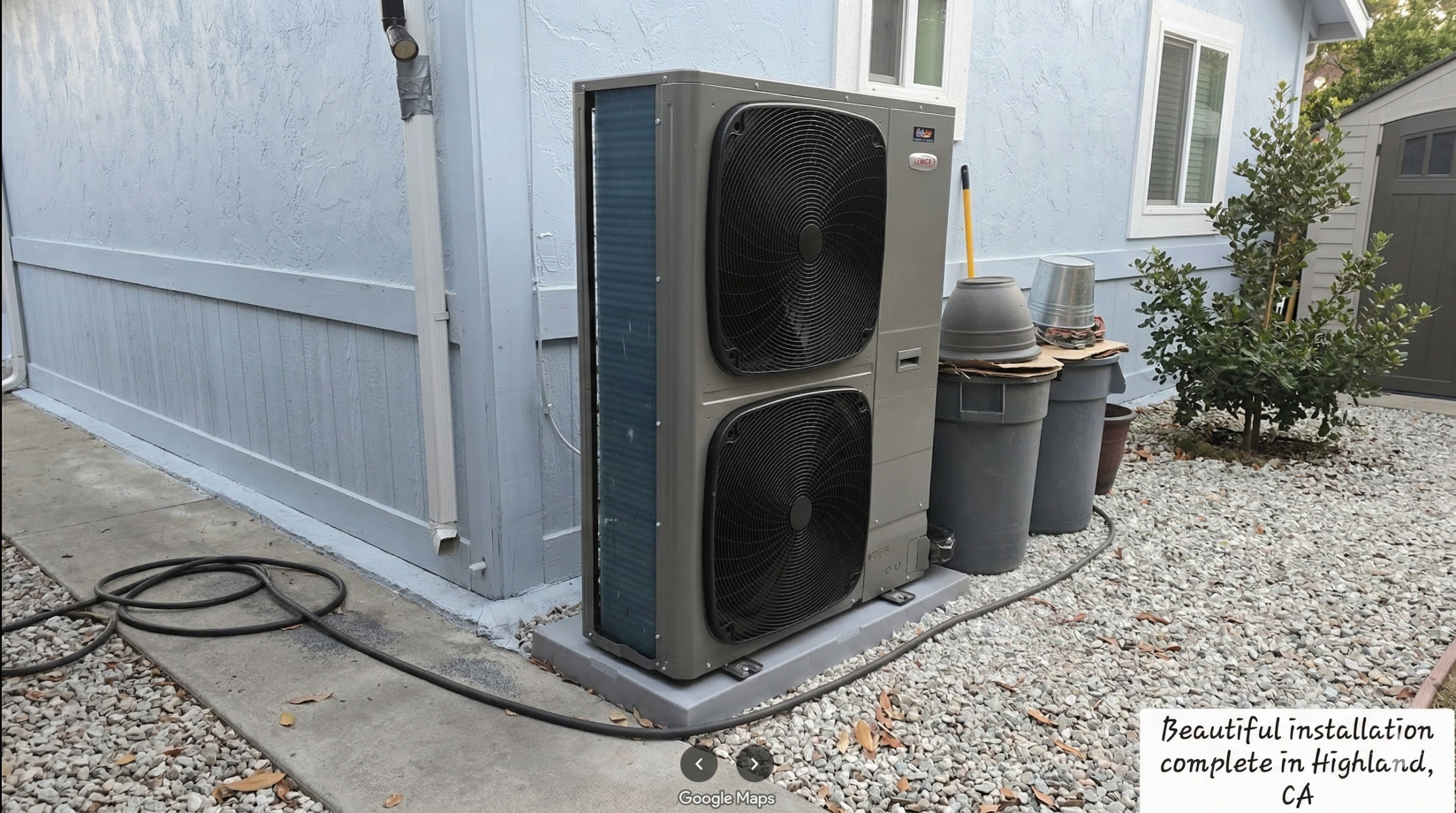
The outdoor condensing unit should be placed on a level concrete pad or wall-mounted bracket with at least 2 feet of clearance on all sides and 5 feet above. In Temecula’s hot summers, the south and west sides of the home receive the most sun and have the highest ambient temperatures — placing the condenser on the north or east side improves efficiency. The unit must also be accessible for annual maintenance.
Refrigerant Lines — Vacuum & Charge
This is the most technically critical step and where installation quality is most likely to diverge between contractors. The line set must be vacuumed down to remove all moisture and non-condensable gases — this requires holding vacuum for at least 30 minutes (ideally longer). Skipping or shortcutting this step causes compressor damage over time. Most mini-splits come pre-charged from the factory with refrigerant for a standard line set length; additional refrigerant is added based on the measured line length. As of 2026, new systems use R-32 or R-454B (A2L refrigerants) — installers must be certified for A2L handling.
Startup, Testing & Commissioning
After electrical connections are verified and refrigerant is confirmed, the system is powered on and run through both cooling and heating cycles. The technician verifies operating pressures, airflow, temperature differential, and remote/thermostat operation. Condensate drainage is tested. You should receive a complete walkthrough of how to operate the system, clean the filters, and what to watch for. Manufacturer warranty registration should be completed at this stage.
Mini-split installation in Riverside County requires a mechanical permit. This is not optional and cannot be legally skipped. Here’s what permitting involves:
Permit Cost
$400–$800 typical for residential mini-split permit in Riverside County. Fee varies by jurisdiction — Temecula, Murrieta, and Menifee each have their own permit offices.
Inspection Required
A city inspector must verify the installation before final sign-off. This typically occurs 1–3 days after installation. We coordinate this on your behalf.
Why You Should Never Skip It
Unpermitted HVAC work creates problems when selling your home (required disclosure), can void homeowner’s insurance claims, and leaves you with no recourse if the work was done improperly.
Red Flag
Any contractor who offers to skip permits to save money is not a contractor you want working on your home. Socal AC Guy handles all permitting as part of every installation.
As of January 1, 2026, all new mini-split systems use A2L refrigerants (R-32 or R-454B) with a Global Warming Potential under 700. These refrigerants are mildly flammable — classified A2L under ASHRAE 34. They require installers to complete specific training and use updated tools and procedures. Always confirm your installer is A2L certified before they begin work. All Socal AC Guy technicians are trained and certified for A2L refrigerant systems.